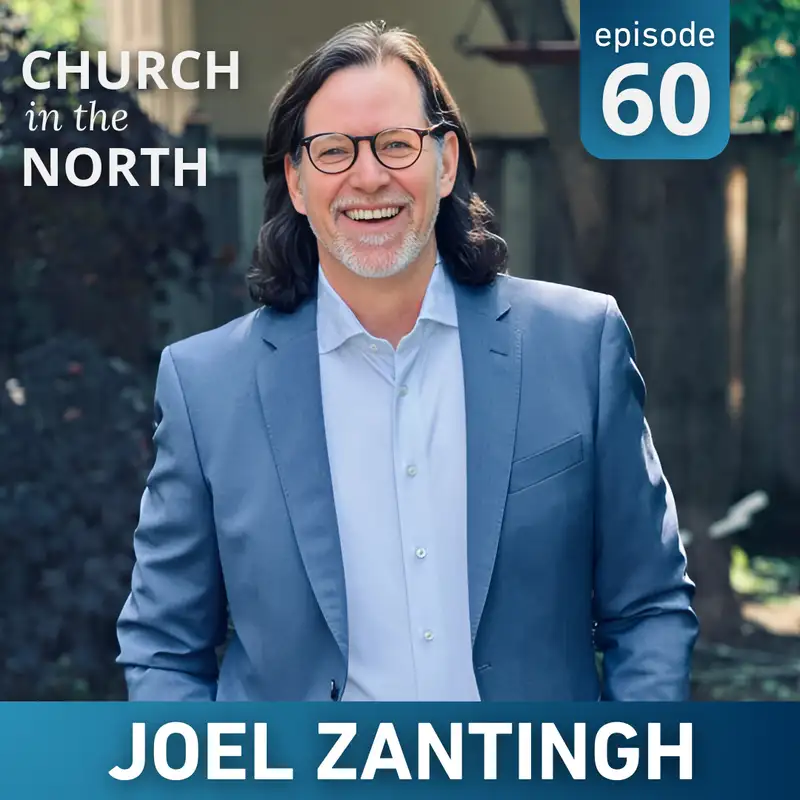
Rob Chartrand (00:02.067)
Well, we are so thankful to have on Church in the North today Joel Zanting. He's the director of engagement for the Lausanne Movement Canada. And I know he's wearing a number of other hats in his ministry roles, but Joel, welcome to Church in the North.
Joel Zantingh (00:15.148)
Thank you, Rob. Great to be with you today.
Rob Chartrand (00:17.824)
Where are you hailing from? Where are you at right now?
Joel Zantingh (00:20.312)
So I'm actually at my home, this is my home office headquarters in Guelph, Ontario, just west of Toronto.
Rob Chartrand (00:28.148)
All right, good. It's great to have some GTA folk around church in the north. Us being in the middle of Saskatchewan, some people in Saskatchewan might not know that area very well, but pretty big metropolis you're in, hey?
Joel Zantingh (00:38.765)
You know, know, Guelph itself is kind of its own entity. It's outside of the, you know, the fringe of the GTA and, and so, yeah, so it functions a bit as a bedroom community, but has its own personality, long history that I've been here since 93 and my wife grew up here. So it's home. It's great.
Rob Chartrand (00:49.578)
Yeah.
Rob Chartrand (01:02.752)
All right, well, hey, we want to jump into your role at Lausanne, and you've been in it for just a year and a half, is that right?
Joel Zantingh (01:10.785)
Yeah, it'll be coming up to two years as we approach summer. So it's been a good run. Yeah.
Rob Chartrand (01:15.998)
Okay, well let's back up the bust. Let's talk about some ministry roles you've served in. mean, in your past, you've been a pastor, but you've had other ministry roles as well. Talk to us about that.
Joel Zantingh (01:29.644)
Yeah, everyone looking back over your timeline and trajectory, this such an interesting experience. So just to acknowledge, I'm turning 55 this year. And so I'm still young, but I started, you know, I did my undergrad right out of high school, a bachelor theology degree in pastoral at Emmanuel Bible College in Kitchener.
Rob Chartrand (01:43.757)
you're young.
Joel Zantingh (01:57.327)
And that was my foray into the evangelical missionary church of Canada, which was the denomination that founded that school. And it's now in other hands, it's connected to base church in Waterloo and surrounding area. But yeah, so I, I just as I was graduating, I started, assisting with this, church that just started meeting in Guelph and thought Christie's from Guelph. I want to go on and do further studies. Let's just plunk down here and.
and serve the Lord and then see what happens. And they called me into a steering committee meeting. So we got married in May of 93 and started attending the church. And that November, they called me into a steering committee meeting and said, hey, and I said to Kristi, I said, I've probably done something stupid and I'm being reprimanded. And I came home that night and I said, they have sensed a call from God to say, Joel, you're here. Will you lead us?
And I started in church planning. I hadn't even graduated yet from Emmanuel. I was 22 years of age, just turning 23. School of the Holy Spirit's leading. So I did that for 11 years and pastored the church from this small group to sort of vitality and life. And we're still members of that congregation. It's now become a downtown city mission church called Royal City Mission in the heart of Guelph. And then I
was also nudged by God, was a pattern here, but I moved on to pioneer the regional minister role within the EMCC. And I did that for 14 years and hired on and built the team. And that model still exists. We used to have district superintendents that would oversee a number of churches, but also hold the credentials of the pastors. And we moved all of that supervision to the national entity, to the president level.
and became a pastor among the pastors so I could provide coaching and resource to pastors and help churches follow Jesus on mission in their context without holding someone's credentials over their head. could walk deeply with pastors through the stuff that they needed support in, did that for 14 years. And then I was involved in the start of the reboot or retooling of our global mission arm within the denomination.
Joel Zantingh (04:20.87)
and did that for a season and it's in the hands of my former associate director. And then now I'm, yeah, you mentioned I'm doing a bunch of things. I'm working part-time with the Luzon movement in Canada. I'm working part-time getting a commission of the World Evangelical Alliance. That's the global body, if people are familiar with the evangelical fellowship of Canada, the global body of the
evangelical alliances around the world. And that commission is called the Peace and Reconciliation Network. So you can imagine at a time of polarization and churches kind of finding their footing in their own locality, some of the national issues of Indigenous, non-Indigenous reconciliation, how to help churches passionate about living for Jesus to process what does it mean to live out the peacemaking way of Jesus, the reconciling heart of God.
And yeah, so I'm doing some other things, but enjoy family life too. That's a big factor. We raised our kids here. They're all young adults now in their late twenties, early thirties. We privileged to do life with four generations. We're grandparents now and live with parents nearby. So yeah, lots to be thankful for.
Rob Chartrand (05:35.636)
Yeah, wow, that's so cool.
Rob Chartrand (05:40.576)
Wow. So that's an interesting trajectory. So I mean, when you left the church in Guelph there in that role, you were like in your early 30s then, early to mid 30s. And then how long were you in that district role then as the shepherd?
Joel Zantingh (05:56.582)
So yeah, 14 years. Yeah, yeah, it really was. So that, was a good stretch, but it was also, it allowed me to keep relationship first in those dynamics. And I just got back from a trip to Nova Scotia where some people after COVID moved out to Nova Scotia and.
Rob Chartrand (05:59.496)
Okay, yeah, that's a long time. Yeah. Yeah.
Joel Zantingh (06:23.365)
connected with a pastor that I used to be the regional minister for him in his church context. And just the sense of blessing as he sort of reminisced on that, also helped just walked right back into what he's doing now. And just the relationships that God has given across the country, many of them still remain. And so when I travel the country for Lausanne or PRN, there's a gift of being able not to
use those former connections just to leverage for what I'm doing now, but to continue to be a leader who wants to bring blessing and encouragement and inspiration to those leaders.
Rob Chartrand (07:06.464)
Well, if we were to plot the trajectory of your ministry career, if we can call it that, you can call it I mean, it starts local, it begins more regional, and now it's even global. Was there a time when you were in your 20s or 30s where the global church was on your radar, that God was kind of doing some things?
Joel Zantingh (07:28.568)
Yeah, the first thing there, and often we read Ephesians 4 and we look at fivefold leadership gifting to equip the church for their works of service, coming to terms with what the gift mix is. I remember the moment when I was pastoring here in Guelph, and she's a friend still, her name is Heidi, and she said, Joel, hang on, when you say the local church, you mean us.
I was already framing my concepts of the church as sort of beyond, and as we think about multiplication and the sort of apostolic heartbeat of God's mission extending outward. And that took me back and I thought, whoa, what's stirring in me for something beyond this single congregation or context? And so it began there. And I spent a number of years as a pastor in the city leading our evangelical fellowship of Guelph, our ministerial.
and collaborating locally. But then, as I was also in that regional minister role for those 14 years, is when I began to be exposed to our global partners around the world, the fruit of national led movements in different countries around the world. had the privilege to go and, and to share in some, interactions and leadership training, giving coaching skills to pastors in different contexts.
So my global map began to light up and I began to see the diversity of ways that God was causing his church to rise, to shine brightly for his kingdom, the holistic nature of that ministry where they would still be running the medical clinics and the schools and attending to clean water and preaching Jesus. And it was all integrated and holistic. And that really formed me.
to give me more of a global heart and kind of prepared me for the work that I would later come to do in trying to sharpen our focus for our global mission around partnership. And what I'm doing now working for two global movements, but trying to bring that to strengthen and support what God wants to do across denominations and theological schools in the Canadian context, because it's that global heartbeat that's come alive in me.
Joel Zantingh (09:54.172)
And it's the relationships that I have with brothers and sisters around the world that I carry in my heart into these conversations.
Rob Chartrand (10:03.882)
Well, let's talk about your current work then. First of all, mean, let's build a bit of a context for our listeners, because I don't think most of our listeners have heard about the Laison Congress. They might have heard about it maybe, but they're actually not aware exactly what it is, right? Because it comes up again and again in different moments in the literature or in, you know, people reference it or whatnot. So can you give us bit of a history lesson on the global Laison movement?
Joel Zantingh (10:32.627)
Yeah, I'd be glad to do that because the Lausanne movement started officially in 1974, that's 51 years ago. And so people would be familiar with Billy Graham, perhaps with John Stott. These dear saints, dear brothers, both from the Euro North American centric world,
began to realize that as Billy Graham said, he would go to Latin America and hold large crusades and all kinds of people would come forward. But, and with all the effort of his organization to encourage discipling to happen, it's still the churches were not strengthened very much and the society itself wasn't experiencing a transformation. And so they began to imagine what it would look like to pull leaders together from around the world.
And so in 1974 was the start of the Lausanne Movement. And it centered as a movement to say, this is grown out of friendship, out of prayer, out of seeking God's heart, listening to one another deeply. And so for 50 years, that's been the spirit of this movement of convening leaders from across the world so that we can hear.
from one another and be aware of some of the contextual issues around the world. you think fast forward to now where the majority world has seen great strengthening within the church, even in terms of numbers, the global South is where the church is the strongest. And so we in North America, how can we continue to lean in?
and listen to that, what I call the wisdom and practice of the church around the world. And stay at the table, stay engaged, but in that spirit of listening and humility and saying, we need one another. We need what God is doing across the continent of Africa and across Latin America. And so for 50 years, the Lausanne movement has existed as this convener. Now, to say that it's only been
Joel Zantingh (12:57.006)
this past September was the fourth global Congress. So it's not centered just around Congresses and meetings, but all the work that's done in between times with working groups around issues and generations, and there are 12 regions. So that's how the work gets dispersed over time, but people are invited into conversations that have an impact together around
fulfilling the Great Commission.
Rob Chartrand (13:28.6)
And maybe that's why it seems more invisible because there are these four big blips that happen on the map and every generation maybe sees one, but you don't always see what's happening behind the curtain, as it were. There's a lot of work on the ground that's being done hand in hand with like just good old practical church work and mission work, right? But then there's the other.
Joel Zantingh (13:51.13)
Mm-hmm.
Rob Chartrand (13:55.326)
side of it where people are thinking critically and thoughtfully and biblically about these issues as they're emerging.
Joel Zantingh (14:00.315)
Mm-hmm, exactly. Yeah, Canada has had a parallel structure. in 1974, coming out of that first Congress, Mariano Di Gangi was a Canadian leader that was instrumental in helping the Canadian committee of Lausanne Global to start. Others would include Leighton Ford, Brian Stiller, T.V. Thomas, Irving Witt.
Rob Chartrand (14:25.716)
Mm-hmm.
Joel Zantingh (14:29.806)
Bob Morris, Robert Cousins and other leaders through different touch points have been able to sort of pick up the mantle on that. But with each of those as well, people might go, I maybe know one of those names or might've heard of them or could quickly Google them and go, yeah, I knew them in this context. But everybody's doing this as well in global networking. There are other ministry capacity.
I work with a lot of people who are multi-vocational. so it isn't always, it becomes a part of the way we think about participating in God's mission. One example of that was the idea for thinking through unreached people groups or least reached people groups, which is a well-known concept. But that was birthed out of the Lausanne Movement.
Rob Chartrand (15:18.75)
Right. Yeah.
Joel Zantingh (15:26.123)
And so we don't always know kind of how to go to the source of where that impetus was, but we can find the gift of that to the global church. And so what are the issues that we get to continue to explore together? That's the...
Rob Chartrand (15:40.51)
Right. Yeah, and that's something we can often take for granted is we, well, everybody knows, well, yeah, but what was its genesis? Where did we begin this conversation? And so it speaks to the importance of the movement and the role it plays in the mission of the church today in the world. So was 1040 Window something that came out of Lausanne as well, or does that's another, did it have its genesis somewhere else?
Joel Zantingh (15:47.746)
Yep.
Mm-hmm.
Joel Zantingh (15:58.892)
Mm-hmm. Mm-hmm.
Joel Zantingh (16:08.417)
So certainly the 1040 window was the acknowledgement. It was built upon that sense of unreached people groups or least reached people groups and then immediately became this framework to identify the portion of the world that had the most connection to that concept. So it's not rooted with Lausanne. Now you're going to make me Google that.
Rob Chartrand (16:34.208)
Were there any? Yeah, well, well, I was just curious. Our listeners can start Googling right now. So were there any other prevalent issues or concepts that came out of that first lasagna that are worth noting?
Joel Zantingh (16:49.322)
Well, certainly, this to your point earlier, remember you said like, there are probably people who go, laszlo what? Like, what is this? And certainly at a, across the church, but even at a leadership level, we might've referenced it in a paper somewhere or something like that. And what's interesting is that the founding document was the laszlo covenant and
Rob Chartrand (16:59.402)
Mm-hmm.
Rob Chartrand (17:17.653)
Yes.
Joel Zantingh (17:18.917)
And so the covenant itself for the 20th century has become one of the most significant documents to sort of bind together people passionate about the mission of Christ. There are other documents like that through history of the church, but this with John Stott as the chief architect, it became one of the most significant documents in modern church history, kind of shaping evangelical thinking.
for the rest of the century and everything else builds on this. the movement still uses this as a foundation. And so I'll meet with like newcomers or ethnic church planters, diaspora leaders in the Canadian context. And so diaspora are just the dispersed peoples throughout the world. And so we might recognize that there are these pockets all across Canada
of these churches and they have a lot more recognition in their homelands of the Lausanne Covenant. Most of us use other kinds of statements of faith that we've organized, but the Lausanne Covenant is both belief, but then action together. And so it becomes a significant document that Christian ministries the world over have used to say, we ascribe that this covenant
will be ours and that we enter into this spirit of joining God's mission with brothers and sisters around the world. So the Congress produced the covenant and that continues to be really instrumental. There's one other thing that really happened in the first Congress. In the meetings that led up, there was a meeting in the 60s in Berlin where
the leaders were convening and pulled together the Latin fraternity. And the Latin fraternity brought with them a concept called Mission Integral or Integral Mission. And this was that holistic effort that was the time, it was the same era as liberation theology, but the evangelicals gathered together in the Latin fraternity and said, we need to keep
Joel Zantingh (19:42.691)
strongly aligned the work of proclaiming Jesus Christ as Lord and existing to address social justice, social needs, and particularly God's heart for the poor. So there was this listening to what was needed to be heard out of liberation theology and then tying that into let's not eliminate the need to preach the good news. And so that integral mission
uh, became an idea that, that found its way to the first Lausanne Congress got really fleshed out in the 2010, the third Congress in Cape Town, uh, South Africa, where the Cape Town covenant carries with it a lot more of that holistic mission. Um, and can I say like, to be honest, that, uh, it's still is something that ebbs and flows. And right now there would be, so you think about.
this in the Canadian context that people who are struggling with identifying as evangelicals, maybe because of what's happening south of the border, there might be other issues of not dealing with, you know, with sin in the church, kind of overlooking issues of sexual misconduct and so on, brushing it aside. And so people are saying, well, my faith, I have a hard time sort of
proclaiming Jesus, I'm gonna lean into just living a life of witness. And so the integral mission framework would say, originally it was the proclamation of Christ that needed that impetus to say, let's keep social action and social justice married. Now I would say we work with people who follow Christ with a very social justice orientation to say, according to 1 Peter 3, 15, 16.
Live your life in such a way, being worthy of being asked the question, what's the reason for the hope you have within you, but be ready to give witness that Jesus is Lord. So how do we keep those together?
Rob Chartrand (21:42.164)
Yeah, for sure.
Rob Chartrand (21:49.29)
So would Lausanne have been a course correction to what's referred to as the modernist fundamentalist controversy? You know, the context of that for our listeners is second decade, early 1900s, where you have these modernist liberal theologians beginning to work their way into the church. And so the fundamentalists arise and say, no, no, these are the fundamentals of the faith. But
fundamentalists are predominantly thinking about evangelism and the modernists are fundamentally thinking about social justice. so the fundamentalists basically throw out the baby with bathwater and say, anyone who's into social justice must be a liberal. We're not going to go there. We are going to focus on evangelism and we'll let those folks focus on social justice. And so the baby that you're throwing out with the bathwater with lack, you know.
Joel Zantingh (22:33.529)
Mm-hmm.
Joel Zantingh (22:40.463)
Mm-hmm.
Rob Chartrand (22:45.466)
is in fact being the hands and feet of Jesus in very practical ways. And so you see this predominantly rising up within a very strong North American church and kind of finding its way like yeast to the whole dole across the world. And Lausanne, is that a bit of a course correction to that? Because I know Billy Graham would have been saying, no, no, no, we can't just do, we have to actually focus on social justice. And he certainly was a,
Joel Zantingh (22:49.327)
Mm-hmm.
Joel Zantingh (23:02.85)
Yeah.
Joel Zantingh (23:13.527)
Yeah.
Rob Chartrand (23:15.198)
a neo-evangelical response to fundamentalism.
Joel Zantingh (23:18.881)
Yeah, exactly. And fundamentalism also began to experience a reaction to some of the higher criticism that was being applied to the scriptures and a lot of the theological schools that were embedded in universities kind of went more liberal in their understanding, looser on the authority of scripture and so on. So this also then ties in, rightly or wrongly, you might think of Bevington's quadrilateral as well.
Rob Chartrand (23:31.744)
That's right.
Joel Zantingh (23:48.778)
which keeps the crucicentrism, the centrality of the cross and the significance of Christ's death, burial and resurrection for our salvation front and center. But it also has an activism involved in it, that it has to be a living faith, along with biblicism that we believe in the scriptures as being the authoritative word of God and crucicentrism, the dying to self that's needed in order to live.
Rob Chartrand (24:15.7)
Right, conversion.
Joel Zantingh (24:17.9)
and be converted and now live for Christ. So that's Bevington's quadrilateral. Many of your listeners will be familiar with that. So it was a way of listening to the global church and saying, yeah, there's something here that we might be three out of four point Bevingtonites if we kind of dispose of activism as being disconnected from things. But how do we keep it in?
in our framework as we're discipling people because even in terms of spiritual disciplines, personal or corporate, we can kind of leave out service to God by serving the world or we can think about moral issues in our culture and I'm not picking on anybody because these are big issues. We can care about defending the rights of the unborn but we miss the moral obligation in scripture to care for the
Rob Chartrand (24:50.464)
Yeah.
Joel Zantingh (25:15.975)
or the sojourner in our midst to care to see immigration as a moral issue. So we can, you we sort of say we want holiness, but we want it for personal holiness and the things that matter to God, I understand over here. And so let's get people converted and it'll all sort out. But there's also the action of our faith in society and it's more fully orbed than sometimes we give it credit.
Rob Chartrand (25:42.686)
Yeah, yeah. Well, I want to come back to that. I want to put a pin in that conversation because we're going to talk about it when we talk about one of your Canadian distinctives because that does kind of play into this conversation a little bit. This tension between evangelical mission in terms of the proclamation of the gospel versus other aspects of what that God's larger mission is. just really quickly, like
What is Lausanne Network in Canada's purpose? mean, how is that distinct, say, than or part of the larger movement that's happening in the world? Give us a bit of your stump speech.
Joel Zantingh (26:20.137)
Sure. So the stump speech officially, like Lausanne Canada, our mission is to encourage and facilitate the involvement of churches, denominations, ministries, networks, and individuals in participating together in the mission Heart of God. It's that missional call of the church. But the insight there that Lausanne uses the language of the four A's, so across the
Academy, the Assembly, the Agency, and the Agora, or the Marketplace. And that's really important because the gift of having all four of those different streams of voices involved affirms, the Marketplace affirms the everyday call of followers of Jesus out in society, but that we need the serving and stated leaders in churches and denominations, mission agencies, and the Christian Academy.
to process together. Lord, what are you saying now? What is the fresh innovation that you want to give us, fresh imagination for participating in your mission? What are the issues we need to deal with? But it's a two-way street, almost like a two-way conduit, where you're right, we are a part of Lausanne Global. And so we want to invite and kind of visualize a two-way conduit. We want to invite Canadians
thoughtful practitioners to participate in collaborative action and discernment with brothers and sisters from across the world on these major themes that emerge. I'll talk about those in a bit. the other direction is what I mentioned earlier, how do we listen and discern what God's speaking to the global church that has relevance for our contexts here in Canada? And so that's the work that Lausanne Canada is actually
coming out of the Congress last September, we're working on a fresh strategic plan and vision for how we listen together to what the Spirit of God is saying in this time and how that gives us clarity for the road ahead.
Rob Chartrand (28:33.376)
Okay. So talking about that Lausanne conference in Seoul in September, wasn't it like the largest representation or for the first time in history that we had leaders from all around the world? Isn't that I think I heard something like that.
Joel Zantingh (28:49.402)
Yeah. Yeah, it, it was very substantial, a little overwhelming in fact, because there were over 5,400 leaders from over 200 nations gathered in Korea last September. And, and then there were thousands more gathered online. I don't have an accurate number of, of the virtual participants. and so.
Rob Chartrand (28:57.599)
Okay.
Joel Zantingh (29:17.772)
And from Canada, just to kind of break down how small our numbers were, we had 185 Canadians participate on site and 140 others online, listening, learning, asking, how do we declare and display Christ in today's world around the core themes that were being addressed there.
Rob Chartrand (29:39.52)
That's still pretty good representation when you think about the size of Canada from a population standpoint compared to the rest of the world. We're not a very, very populous nation.
Joel Zantingh (29:49.4)
Yeah, yeah, we were involved in raising funds that would go to global global scholarships to help sort of with some of that equity and accessibility for people to get there from different countries. But even in terms of our own representation, we tried to push into some of the targets that Lausanne had set for this gathering. And this was an interesting shift.
Um, because as I've been talking so far, people might say, Lausanne sounds like a bit of an ivory tower environment. And, uh, it's, one of the goals for this Congress was, uh, to have, you know, 40 % that were under the age of 40, younger leaders, 40 % women, um, that there was a desire to have at least 25 % of the, the, the crowd there who were marketplace, uh, leaders, people who did not.
receive primary salary from gospel work in stated or serving leadership, but who worked in other sectors. And so it provided then this sort of next gen and laity inclusion into drilling out how do we listen together to the global church. It was a fascinating kind of shift in the movement.
because you'd have young leaders saying, I didn't realize I was sitting across the table from the president of such and such denomination. And I just saw them as Tom or whatever. And so it was this really fascinating dynamic.
Rob Chartrand (31:33.664)
Was there any criticism for doing it that way? Like for in terms of being very intentional about siloing certain age demographics, certain gender demographics? so I just try to think through some who might be concerned. Well, it's being very structuralist or anti-structuralist. And so the critical theorists are influencing LaSalle or perhaps
Joel Zantingh (31:56.576)
Mm-hmm.
Rob Chartrand (32:03.204)
you're becoming more liberal in moving in this shift because you're bringing women in instead of men, et cetera. Was there any sort of flack with that from the global church or from North American church?
Joel Zantingh (32:14.549)
Yeah, there certainly was pushback on that. And when you think about Canada, we still have a range across the evangelical bodies in terms of our theological understanding and activation of women in roles of leadership. And we see this in our theological schools and in the books we're reading and all of that.
Rob Chartrand (32:27.669)
Mm-hmm.
Joel Zantingh (32:42.465)
We come in, we tried to enter that space with a sensitivity to create some room and some space. And that's why these things are targets rather than mandates. in terms of platform representation as well, there were voices from more marginalized communities. And that included, you know, women, panel of young leaders.
believers in conflict zones, from closed access countries, from all around the world. And so there is an acknowledgement when you start to include laity that the Great Commission is given to all believers, all of us collectively, to go and preach the gospel to all nations. so that sense of
being those who live and proclaim, who declare and display Jesus Christ together is the entirety of the body of Christ. And so I think that they were able to stick handle some of that awkwardness and pushback. But the other thing is when you get into these large, large gatherings, it might be an ecumenical space.
to one degree, like we do have diversity even within those that would call themselves evangelical or committed to the gospel of Jesus and framing that, preaching the good news, living the good news. But when we think about something that gets missed when we come together, we have to be explicit that this is a wide tent environment. And if you've been in some of these wide tent environments,
Rob Chartrand (34:34.579)
Mm-hmm.
Joel Zantingh (34:38.302)
We are going to disagree on matters and even unwittingly offend one another. we might see things happening from the platform, or the central microphone that we disagree with. And we're going to create space, which values one another, which honors one another, despite some of these differences. And I think that's a, that's something that we, we need to need one another more.
than we do. We often can get locked into our particular way of framing our theology and say, I have this sense of the unity of the body of Christ, but I know who I really want to work with and be associated with. And those that I see as not interpreting the scriptures in a godly way. So can we create that space in our heart to work with those with whom we disagree?
on some of these issues. And we don't all parse out, know, we say, well, maybe it's easier to say, let's have agreement on essentials and liberty and non-essentials. We don't even agree on all the essentials all the time. And so how do we create a sense of God's mystery to work through streams of the body? Richard Foster had his book, Streams of Living Water, maybe. I'd have to Google that, but if that's the correct title.
Rob Chartrand (36:02.538)
Yeah. No, I think that's right.
Joel Zantingh (36:06.696)
And so what do we learn from the various streams of the body of Christ? Even if we know that's not where I personally land, but boy, can I see God at work among Orthodox church, Catholics. If we're looking for what God is up to, we can actually find that God's vision of the church is much broader than ours.
Rob Chartrand (36:33.088)
Well, and I think some of those issues that I referred to are very North American issues and for much of the global church, they're not even thinking about those categories or even concerned about those things. There's much bigger, more prevalent in their face issues than say critical theory and those types of issues. I think that's accurate. Would you agree with that?
Joel Zantingh (36:57.994)
Yes and no, I would say there are more matriarchal societies and portions of the body around the world that are more open to that. But there are still sort of male dominating leadership cultures. Okay, so it is an issue. And if we have, if we put forward
Rob Chartrand (36:59.178)
Okay.
Rob Chartrand (37:17.502)
Yes. Okay. Yeah.
Joel Zantingh (37:26.996)
women leaders as opposed to women and men leading, serving God together, that can create some barriers for some, and even within our own country, even though Canada is listed among the sort of higher egalitarian cultures, that women still face a limiting on their spaces where they can lead in certain circles. And some feel
Rob Chartrand (37:31.37)
Mm-hmm.
Joel Zantingh (37:55.127)
that's fine and they serve within that. There are women who are more complementarian, for instance, in their understanding of scripture. so we want to bless women, however, and wherever they are serving the Lord in their areas of gifting. And I think one of the hacks there for me in my life and my journey is to take a giftive approach, which is that if God
gives gifts of leadership to women, then how do we foster that and create space for them as opposed to creating unnecessary ceilings or barriers? There are people who are doing that more deliberately in their ministry focus that just becomes part of this wider tent emphasis within Lausanne.
Rob Chartrand (38:43.796)
Yeah, yeah. Well, I mean, certainly for Church in the North and even here at Briar Crest, I mean, that's our posture. have disciples participating in our school as faculty, as well as students who are on both sides, know, complementarity, egalitarian for, you know, to use really simple terms. And yet to working together to say, well, what's the greater mission here that we're trying to work out?
And what's the primary, the essentials versus the non-essentials? And can we still work together even though we have some disagreement or questions about our different theological positions? And I think the answer is always unanimously yes, absolutely. Of course, of course we can. of course, the challenge is what is essential? And so some things get bumped up as essential issues versus non-essential.
Joel Zantingh (39:27.426)
Mm-hmm. Mm-hmm.
Rob Chartrand (39:39.944)
I don't want to go down that rabbit hole anymore. Let's talk about gaps. I looked at the website for the conference, the Congress in Seoul, there's this whole page that gives this whole list of gaps that they're trying to talk about and address. Can you talk about that a little bit?
Joel Zantingh (39:44.194)
Sure.
Joel Zantingh (39:58.218)
Yeah, I would, I think that there's some helpful Stefan Lazon's YouTube channel to kind of overview the gaps. And I would refer people there, maybe we can put that in the show notes and that'd be really helpful because there were sessions of teaching, of studying the word of God or the book of Acts about the gospel, sort of expanding cultural, geographic, linguistic barriers.
working through the issues of our own ethnocentrism or our own theology and how God needs to give us a sense of his heart for his mission. If we are going to display and declare Jesus together and we're going to accelerate global mission together, then we need to address some of these gaps. Now, the gaps were revealed in the State of the Great Commission report that came out ahead of the
Congress and participants entered a year-long journey of going over the older documents like the Lausanne Covenant and watching previous footage and then being a part of regional consultations that gave shape to what are the gaps globally that God's putting his finger on as we listen to the church. And so we've heard that, you know, the mission of God is no longer from the West to the rest of the world.
Rob Chartrand (41:25.706)
Mm-hmm.
Joel Zantingh (41:25.965)
And the missiological term there is that we're dealing with an era of polycentric mission. So the Canadian engagement with one of those gaps would be polycentric missions or polycentric resource mobilization. How do we both bless more mutuality with brothers and sisters around the world to live as sent where they are?
but also to respond to the heart of God if God's asking them to serve cross-culturally. One of the examples in Canada is the God stirring the hearts of people from the African continent to come to Canada to help participate in reaching people who don't know Jesus here. And so you'll run into like people responding to the heart of God. We have a history of being known as senders, but how are we doing at receiving?
people that God is sending to us. And so these gaps get fleshed out in terms of how we collaborate together. it's a polycentric mission would be one. Another area of gap around what does ministry of mission look like in a digital age? What about church forms or discipling or evangelism in a digital age? And so some of your listeners might...
be on Discord and gaming platforms and trying to figure out how to connect relationally with people and just respond with the gift of the good news of Jesus at the right time in those digital spaces. So it was a whole digital resource center set up and there's people discussing this, right? Because we talk about this from a landscape of, what is the nature then
of how we respond if people are only sort of ministering in a digital sphere. And in our Canadian follow-up conversation, it's like, how do we integrate online witness with offline witness? That we can't just immerse ourselves in digital space with people around the world, but that can be a part of it. But how do you get to know your actual neighbors that you live next to and have a connected relationship offline? So there's a couple of examples.
Joel Zantingh (43:49.819)
Can I give you a couple more? Okay. Ethnicism and racism. As we talk about the church strengthening in the global South, there can still be a sense of people feeling marginalized and sort of siloed, especially like diaspora groups that come to Canada and pastors who are credentialed elsewhere in the world whose credentials.
Rob Chartrand (43:51.092)
Yeah, please. Yeah.
Rob Chartrand (43:55.904)
Mm-hmm.
Joel Zantingh (44:16.206)
You know, they get that letter saying we're moving in another direction from a church, but there might be some actual discomfort from having somebody who has ministered and served in the African continent to come here. Well, how do we address that gap from a sense of both, you know, ensuring that we're creating space for, for the diversity of the body of Christ, but how to move congregations, how to do change management wisely.
and address some of that. Caring for creation and the vulnerable. And this ties back to that integral mission conversation. So what does this look like now that we not only have refugees fleeing conflict, but we have refugees fleeing climate crises. And that's on the rise. So can we talk about what is caring for creation and for the vulnerable?
who are living where their community is now underwater or the devastation of drought and so on. What does it look like to be agents of the king to address that? So there were all these different gap conversations.
Rob Chartrand (45:28.0)
So let's talk about some of those gaps and I'm hoping we can spend kind of park here for much of our conversation now. Let's talk about the creation care one first. mean, because I noticed on the Canadian website that creation care seems to be kind of a distinct emphasis of the Canadian Lausanne movement.
Is that something that's new? Because I mean, like, there's even like a placeholder on the website that specifically addresses it. Is that something that's new for the Canadian context or is it something that's been growing?
Joel Zantingh (46:04.36)
I would say that it's something that has been growing, over the last decade. it's still controversial. We, know that there are, people who say climate change isn't real. and, so the Canadian who actually spoke on this at the Congress, is Katherine Hayhoe and she lives in Texas. She's known all over the world and she has a
fantastic YouTube channel, shout out to Catherine's work, but she calls it global weirding. And she's like, there is a sense of responsibility. When we read the scriptures and we talk about God in Colossians 1, for instance, this cosmic reality of the gospel, that Christ has been given all supremacy over all powers, rulers, authorities.
But it goes on to say, and through Christ, God was reconciling to himself all things, all that he has created. So throw back a little bit to how we read the, you know, after the ark, we read the renewal of the covenant to Noah, we say. But go ahead and read that covenant. It is a covenant with all the creatures and all that God has made.
and it's holistic and it's an impact on creation. So when we talk about the ministry of caring or stewarding creation given to Adam and Eve to tend and steward, it isn't a domination and a destructive pattern. It is looking at all of creation as good as declared in Genesis 1 and our calling as human beings.
to steward and tend and care for the earth. This is what Indigenous leaders in Canada are calling for. So when we started hearing those longings from ex-Vangelicals and from people within the Evangelical community saying these things, I'm looking, I wanna do a degree in international development, I'm passionate about this. Is there a place for that in the mission heart of God?
Joel Zantingh (48:24.094)
And we were seeing these things begin to pop up and emerge. And so for us, it has become an emphasis. Now, at Rocha, Canada is a network that exists globally, but these are people that are a Christian organization that deals with watershed management and leans into creation care. So we had some of our representatives there and we're in contact with them.
Likewise, Tear Fund Canada, which is one of the development organizations with its roots in the UK. The Tear Fund stands for the Evangelical Alliance Relief Fund. And so it has moorings within the evangelical world and it's well known all over the world. And so when we talk about this as a gospel issue, we are rooting it in that sort of
reconciling heart of God for all things and all creation and just doing a better job of making sure we are not abusing the earth. Now it gets co-opted as people think about this as something that's politicized, that's spoken against as not being real or true. But can we acknowledge that some of that is influenced still by sort of how Lindsay and
This world's gonna burn and destroy. It's not the vision for God renewing all things and heaven coming down to earth and being reunited in revelation. And think N.T. Wright, who talks a lot about that. So yeah, there's theological learnings. Like where you start in this conversation really, you know, kind of gets worked out in a different way.
Rob Chartrand (49:51.86)
Yeah, yeah.
Rob Chartrand (50:15.998)
Yeah, well, think you look at the Canadian website and creation care is there, but you look at the Canadian political spectrum of where we're at right now. I climate issues has been kind of top of mind for our national agenda, right? And so some people might be suspicious and say, wait a minute, is this political reality
really affecting Luzon, Canada, right? And I think that your appropriate response is, well, no, mean, whether you think climate change is a reality of human instrumentation or whether it's a reality of just incremental degradation over time or a little bit of both, that's a moot point. The reality is from a biblical standpoint, we are to care for God's creation, full stop. I mean, that's...
Joel Zantingh (51:06.353)
Mm-hmm.
Joel Zantingh (51:12.154)
Mm-hmm.
Rob Chartrand (51:13.692)
I mean, and our future, our great and future hope, you know, to lean into N.T. Wright a little bit is grounded in a new creation and our future is in a new creation. so Christ came to reconcile all things to himself. And so we are to live now as we will live then. Let's care for the creation, which is good in the now as it will be in the not yet.
Joel Zantingh (51:24.08)
Mm-hmm.
Joel Zantingh (51:30.47)
Mm-hmm.
Joel Zantingh (51:40.016)
Mm-hmm.
Rob Chartrand (51:42.238)
you know, in the already and not yet. wherever that spectrum is, doesn't matter really. It's still at the end of the day. We have to care for creation that matters to God.
Joel Zantingh (51:42.768)
Mm-hmm.
Joel Zantingh (51:50.928)
Yeah. Two things we must not ignore, even if we don't believe all the hype, don't believe the stories. I, I believe it's important to listen to brothers and sisters from around the world in this conversation. And that's why it's such a gift to be in the Lausanne space to have this conversation because we're working with people who are facing the highest devastation from
Rob Chartrand (52:07.029)
Mm-hmm.
Joel Zantingh (52:15.813)
climate change and all of that, where they are living and serving and they are our brothers and sisters in the Lord. And it's so, I think that's an important piece. And the other is that it's in the heart of God and in the scriptures. And so there is a creation care group that has been functioning for a while. They did a tour of global meetings a few years back. I was able to
Prior to even coming on with Lausanne, I participated in their event in Sub-Saharan Africa with leaders in the African context. So listening firsthand to the impacts that they were dealing with and learning how to respond to that was just a joy and also a wake-up call for me. And so let's say, what is it that we understand and can learn from reading God's word?
through this caring for creation lens from beginning to end of the story. And what are brothers and sisters around the world saying about this that we need to pay attention to? And then let's respond politically, sociologically in terms of our personal and corporate choices. So I'll give you an example. Arasha is working in Canada and around watershed management and land stewardship. So a lot of...
churches that have a bit of property, they could do more to plant pollinator gardens and have more care for the earth that replenishes the earth around them. So if we have that kind of conversation, it doesn't mean that we've drunk the Kool-Aid of something we've said doesn't exist, but it's like what kind of demonstration of that would make a difference as we still hold our cell phones made with oil and
you know, drive our cars that run on fossil fuels and are involved in that. So it isn't one or the other. That there is a sense of how we are doing the best we can, but not to avoid these as a part of our faith and to integrate that in our thinking.
Rob Chartrand (54:09.812)
Right.
Rob Chartrand (54:32.35)
Yeah. So let me give a little pushback on it. And I want to get your feedback on this. David Kidman, his book, Faith for Exiles, talks about millennials and Gen Z, older Gen Z, and how within that demographic, there is a greater propensity towards leaning into social justice issues and away from evangelism.
Joel Zantingh (54:37.184)
Mm-hmm.
Rob Chartrand (55:01.17)
And part of the reason is obviously social justice issues can be invoked. They can be more sexy. I mean, like you can get some traction if you jump in on social justice, right? Whereas if you lean into evangelism, I mean, you tell people that, you you're far from God and Jesus is Lord of all, and you need to repent and return to covenant with him and into relationship with him and repent of your sins and all of that, that doesn't get you a lot of friends. That's harder. Evangelism is much harder.
The predominant voice of Lausanne since its early beginnings has been the primacy of evangelism, of witness. so are we becoming kind of materialists here where we're just leaning into creation and worried about this planet, whereas at the end of the day, what really matters is the souls of people? So are we losing that? And for, I'm thinking,
particularly about, you I work with college students, 18 year olds, and I teach a class, evangelism and discipleship. But I also beat the drum on, you know, on the importance of creation care and all of that, you know, and on social justice, but still maintaining the primacy of evangelism. So this is a tension point. Is leaning into creation care going to take us away from our primary concern, which is evangelism?
Joel Zantingh (56:04.393)
Mm-hmm.
Joel Zantingh (56:14.706)
Mm-hmm.
Mm-hmm.
Joel Zantingh (56:29.417)
Yeah, don't think it has to. I think it's possible that it can. One is that millennials, some older Gen Z, as you call them, or as you mentioned, might be leaning into that. And we need to ask why. So one is, our schools of higher learning have also come at a time with
Rob Chartrand (56:33.535)
Okay.
Joel Zantingh (56:59.815)
you know, more of a push on social justice issues. We're seeing it in our society with increased individualism and, you know, lower church attendance and as a society as a whole. And so we look at those things and we say, is there a replacement of the importance of the good news of Jesus Christ?
in pursuing some of these other ways to try to live transformationally or make a difference. And so that's part of the water we're swimming in. And so I think the gift of including this in our discipling is that it is not an either or. And perhaps it's a critique of its neglect in the past that has led to it being pursued outside of the gospel.
So as an integrated system, for instance, how can I say, and Catherine Hayhoe has spoken on this, but how can I say I love God and neighbor when that neighbor is homeless or landless or familyless or stateless and needs the hope that comes from the gospel of living for Jesus, but I neglect the issues of the context someone else lives in and God's desire to renew the land.
Like there's something beautiful about not just saving the soul, but equipping people to live as those who demonstrate the good news, the renewal of all things, the now and the not yet. And so there is a theological paradigm for leaning into justice issues that is still distinct in the Christian faith to care about the sojourner, the stranger, you know, the quartet of the vulnerable in the Old Testament.
and widows and orphans and the poor. And so we are at a place now in our country with our epidemic of more people who are living with housing insecurity, living street involved. But when we think about our opportunity to lean in, it is not simply to get them to pray a prayer of salvation with some mental assent to Jesus, but to
Joel Zantingh (59:24.238)
to care for them in the way that Jesus calls us to, know, Matthew 25. And when we think about clothing, the naked and visiting those in prison, and there is a nature of Jesus' own manifesto in Luke four that sets that out for us. So the calling of living the good news cannot just be a spiritualized reality. It has to be a lived faith. And I think
Sharpening the edge and I don't get a bit preachy but the sharpening of the edge of holistic gospel or integral mission is one of the ways that we can restore this sense of balance to bring back pieces that have been falling apart from each other for a while and So yeah Colossians 1 ends that that God in Christ Jesus was reconciling to himself all things
Rob Chartrand (59:57.044)
for it.
Joel Zantingh (01:00:20.122)
by making peace through his blood shed on the cross. When's the last time I preached about the cross, the efficacy of the cross to restore all things, right? We tend toward personal salvation. And that in itself has shown to be harmful and it's leaving these vacuous questions for believers who are saying, well, this other stuff doesn't matter, but it does matter. It matters to me. It matters to what's going on in the world. It matters to my global neighbors.
Rob Chartrand (01:00:30.09)
Yeah. Yeah.
Joel Zantingh (01:00:49.441)
It matters to future generations. So I think that's a way in that avoids some of just the political pushback on this.
Rob Chartrand (01:00:59.136)
Joel, do you have a garden?
Joel Zantingh (01:01:02.04)
I have a really crappy yard and I grow like tomato plants in pots and herbs and so on. And so it's not good sunshine back there and we've tried to grow things. We do that. We lean in. And so, yeah, so I'm supportive of the sort of new shared economy and have family members who do the gardening and
Rob Chartrand (01:01:09.408)
Okay.
Joel Zantingh (01:01:31.288)
And I do the other aspects of participating in that. It's a good question.
Rob Chartrand (01:01:35.648)
Well, you got tomatoes in pots. So I mean, that's a great first step. I mean, that's important. Yeah, I got it.
Joel Zantingh (01:01:40.12)
Yeah, I can feed myself for one week.
Rob Chartrand (01:01:44.402)
Yeah, make some salsa. Yeah. Yeah. We have a ginormous plot of land. My wife, my wife's parents farm. They, they're no longer there. They've moved into town, but there's a huge plot there and I got a huge garden and I get my hands dirty and there's just nothing quite like cultivating creation. There's just, yeah. And so we are cultivators by nature to, to borrow Andy Crouch's words there.
Joel Zantingh (01:01:46.52)
you
Joel Zantingh (01:02:04.812)
Nothing like it.
Joel Zantingh (01:02:09.451)
Mm-hmm.
Rob Chartrand (01:02:14.278)
And I think we need plant gardens and do the work of an evangelist hand in hand. Social justice is probably a larger category that's most worthwhile saying. So we need to do both. And so that great divide, the schism that happened in the modernist fundamentalist controversy, I think we bring them together and we do an inch of separation and we make evangelism primary, but we don't ignore
the issues of social justice that are grounded in the reality of people's lives.
Joel Zantingh (01:02:45.12)
Mm-hmm. Mm-hmm.
Yeah, and the word of God. So for us, it's a contextual issue. You know, I saw on my newsfeed this past week, a stat from Ontario Nature, that's, you know, nature's foundational Canadian identity that they record that 62 % of Canadians are concerned about climate change, its potential impact on our future. So it's in the thinking, it's in the water, it's not 100%, right? But it's out there.
Rob Chartrand (01:02:54.036)
Mm-hmm.
Joel Zantingh (01:03:18.03)
And so to protect forests and wildlife, there've been my whole life, there've been people involved in that. It just has been separated, as you say, bifurcated from my faith. And so how do we instill a sense of the connectedness in that? And LaZonne can help with that and some of these other partners that I've mentioned.
Rob Chartrand (01:03:40.116)
Yeah, like the earlier on you're talking about the, what was the term you used? yeah, polycentric. The reality of how the world has changed. And if you go back to say 1910, Europe and North America were predominantly the center of Christianity for the world. is the most populated parts of the world where Christians dwell, the greatest number of Christians. But now that has changed. Now it's like a three centered,
Joel Zantingh (01:03:48.246)
polycentric mission.
Joel Zantingh (01:04:05.813)
Mm-hmm.
Rob Chartrand (01:04:09.728)
part of the world. It's Latin America, it's Asia and it's Africa. And so that's shifted and the reality has shifted to the world. And now we see, I don't know what it is, like 3.5 % of the world's population are on the move. are diaspora people groups living in a nation that's not their own. And that, I mean, we see that everywhere, like here in Mushtaq. mean, we have...
Joel Zantingh (01:04:14.985)
Mm-hmm.
Mm-hmm.
Joel Zantingh (01:04:33.117)
Mm-hmm.
Rob Chartrand (01:04:35.264)
people from the Philippines, obviously, Nigerians in the city, people from mainland China. mean, and this is in a little Moose Jaw, Saskatchewan, where I live. is, it's, it's an amazing changing reality. Yeah.
Joel Zantingh (01:04:43.399)
Exactly.
I met with pastors last week in Truro, Nova Scotia, same thing there. It's hitting our small towns at a time when anti-immigration sentiments on the rise and the government scaled back their numbers just for sustainability. But we need to speak to some of that because the body of Christ is an intercultural church. Yeah.
Rob Chartrand (01:05:07.924)
Yeah. What do Canadians need to be paying attention to when we think about the intercultural church and diaspora peoples?
Joel Zantingh (01:05:18.215)
Well, yeah, that's wonderful. This is going to be fleshed out a little bit. One is that at a leadership level, you know, I would say to all of us as leaders on this podcast, listening to this podcast, how are we growing our and widening our networks of relationships? I came out of a KW pastors meeting and somebody else in that room voiced the concern that we don't even realize
how we are excluding diaspora leaders because we're holding this mid-week on a lunch for those who are full-time employed in Christian ministry. And it's an exclusionary for all the bivocational leaders. So one of the practices in Lausanne's meetings is we hold them, we either hold two or we hold them like on a Friday, we'll have a call and a Saturday we'll have a Zoom call and we'll offer these options.
for people to participate in dialogue and run them twice, which is more work, but it has been life-giving to actually create space and time that works for people who are bivocational to fit this in. And they're grateful. And what it does is it puts me in contact and relationship with more newcomers to Canada. know, EFC has now,
taken over the welcome church material to try to equip churches to receive newcomers. There are beautiful stories emerging in that way. So yeah, people on the move, the intercultural church as leaders and as churches, how are we broadening our relationships to include them in the way that we're thinking about the body of Christ? And that might start as well with sharing facilities owned by one group, but another
needs access to meet. There's good models and, know, Willingdon Church out in Surrey, Bayview Glenn Alliance in North York and Toronto. You know, they have these hubs of, you know, ethnic fellowship meetings, but they meet and worship all together. Churches are beginning to explore how we do this. my challenge would be leaders at a network level.
Joel Zantingh (01:07:42.991)
How do we do this? And so even within, you know, the theological schools that see a lot of draw from cross-cultural or international students to create spaces where we're learning and listening, what resonates in the church, where in your homeland and what is it that God has for us to learn here? So those kinds of impulses grow.
And like I said, I went through a season in my life when God kind of wrecked my small worldview. And now these things are not normal. And I'm not without my biases and my likes. Okay. But the gift is, is that my worldview has broadened. My framework has broadened. And so that's the gift that can come in for the Canadian church. So we want to have that kind of intercultural collaboration.
in the gospel in Canada and are working on now how to develop conversation spaces, resources that can add blessing to that for the Canadian context.
Rob Chartrand (01:08:52.148)
Yeah, I think the Evangelical Church in Canada has benefited and will continue to benefit from new Canadians coming and being part of our churches and even leading in our churches. mean, first of all, they're from warmer cultures and so they're far more communal rather than individualistic, which we need to learn from. They're more prayerful. They're more evangelistic. They're planting more churches than Canadians are, like the classical Canadians. We're all Canadians, obviously.
Joel Zantingh (01:09:03.426)
Amen.
Joel Zantingh (01:09:07.599)
humanitarian.
Joel Zantingh (01:09:17.675)
Mm-hmm.
Rob Chartrand (01:09:20.48)
So there's just so much we can gain and we can learn from new Canadians who are part of our church families. Hey, I want to be honoring your time here. Final question, well second final question, but let's get back to the Lausanne movement in general. If the Lausanne movement disappeared or closed its doors, what would the church be missing?
Joel Zantingh (01:09:23.404)
Mm-hmm.
Joel Zantingh (01:09:30.464)
Mm-hmm.
Joel Zantingh (01:09:46.592)
Yeah, that's a great question, Rob. I think the, you know, each movement that's a part of God's heart reflects his heart. When we talk about the origin story of Lausanne as this friendship with Billy Graham and John Stott and creating a larger table, everyone's table, I think some of that
Some of that has already been happening. So the movement now is valuable to the Canadian church and to the global church to be a part of creating this mutuality. And I'm not saying that it wouldn't exist. There may always be disparity, economic, social, cultural.
We're all kind of doing that push and pull of how we lean into cultural intelligence for the sake of the kingdom. But I think if Lausanne disappeared from that space, with the large ass, you know, the amount of people in this large tent that are gathering and discerning, leaning in to listen to the spirit of God together, how do we display and declare Christ together?
with the fourfold vision. think some of these get picked up by other organizations, know, the gospel for every person, disciple making churches for every people in place, Christlike leaders for every church and sector of society and kingdom impact in every sphere of society. So some of those vision initiatives would get picked up by others, but it's this convening, this ability to listen together with brothers and sisters from across the globe.
that continues to have a fresh energy and a commitment to humility in those spaces, not, oh, I guess I need some global friends, so I'm gonna go and find like-minded leaders from around the world and call that a win. We gotta sit together and discern, am I giving enough space for their voice, whose voice is missing? How do we understand the needs of the body of Christ across the globe?
Joel Zantingh (01:12:11.306)
And we're doing that in hubs and conversations, working through issues, discerning together. It gives an acceleration to working on the Great Commission together. And I think that would be missed if we were out of the equation.
Rob Chartrand (01:12:28.298)
Yeah, I think if Lausanne closed its doors within five, 10 years, all of these other groups would start saying, you know what we need? We need something like Lausanne where we can all get together and have these conversations. So it's meeting a need that is necessary really for the global church and for the mission of Christ around the world. So, hey, as we close, I wondered if you could share a word of encouragement for our ministry leaders who are
Joel Zantingh (01:12:38.856)
Thank
Yeah.
Rob Chartrand (01:12:57.69)
listening from across this great nation.
Joel Zantingh (01:13:00.978)
Yeah. In my context here, I want to say I'm grateful for leaders on the front line working in churches, theological schools, mission agency leaders, marketplace leaders who are serving the Lord Jesus in and from Canada. And one of my practices, I'm still a part of that church that
God led me to plant back in the day, Royal City Mission. I'm there once a month. I'm leaning into local pastoral ministerials in my area because as a globally engaged leader with a global role, I wanna stay rooted locally. And so thank you for where you are rooted locally, equipping God's people to live as sent ones.
And I don't think I, I don't run into pastors who want to build their own kingdoms and their churches. They want their kingdoms, their churches to be centers of gathering the body, inspiring them and equipping them and sending them out the doors. And I say, my encouragement is yes to all of that. And with some of this holistic mission emphasis, I want to pick up on a phrase I learned from a friend, Alana Walker carpenter.
who is serving God, shining light on Bay Street with business leaders in Toronto. And her commission is, and I would say, give this to your people, go forth and be normal. We often think about the big bad world out there, but the light shines brightest in the darkness and to continue to equip our people to live as sent, to go forth and to just.
Get in step with the conversations that the Spirit of God is having with those that you work with and play with. It's amazing what God is up to. There's a renewal happening in our own country, a resurgence among Gen Z and Gen Alpha who are not pursuing the Canadian or the American dream, but are longing for spiritual life to be integrated. They're hungry.
Joel Zantingh (01:15:21.157)
after not having the word of God sort of in society, they're saying, I want to know more, I want to learn more. And so we need to equip our people to go forth and be normal and to just see what God will do.
Rob Chartrand (01:15:37.384)
Amen. Good word. Well, Joel, this conversation has been rich and thank you for giving your time and I want to bless you in the work that you're doing with Azan and all of the other hats that you're wearing. And thank you for sharing with us today.
Joel Zantingh (01:15:53.774)
Thanks so much for your podcast. And I think it's a blessing to have a Made in Canada kind of conversation around this. just grateful to participate in Church in the North and for all that you're doing, Rob.
Rob Chartrand (01:16:11.38)
Well, we'll have to catch up soon and learn a little bit more about what God's up to. Bless you, brother.
Joel Zantingh (01:16:13.677)
Love it. And if I come out your way, yeah, I would love to hang out. Yes. Yeah, we'll go walk in your garden together. Love it. All right. Thanks.
Rob Chartrand (01:16:19.426)
absolutely. I'll show you my garden. All right. Bless you. Yeah.