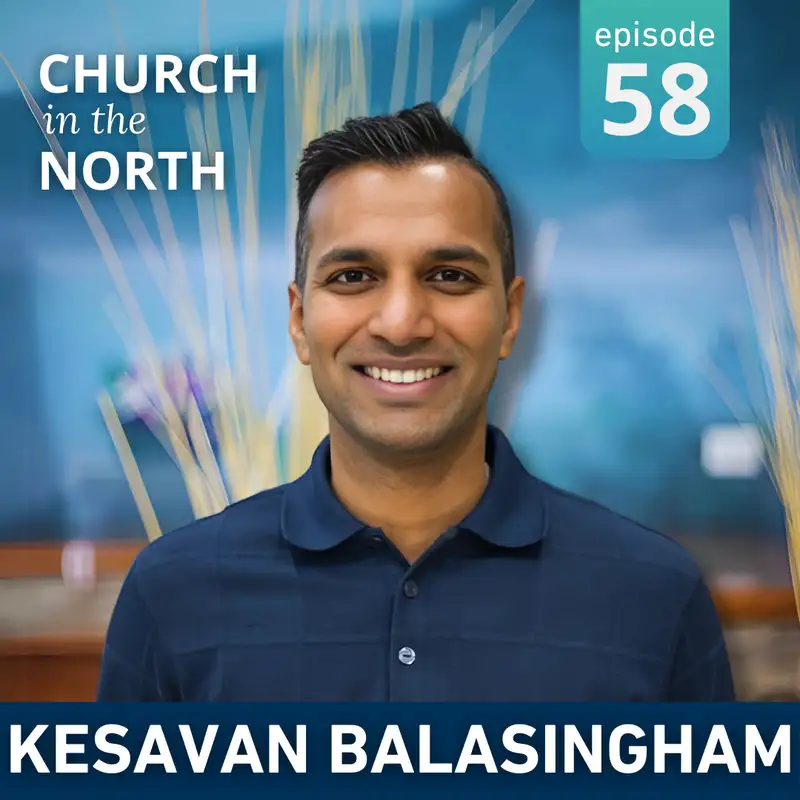
Rob Chartrand (00:00.93)
Well, we are so excited to have with us on Church in the North, Kasevan Balasingham, and he is the pastor at Fellowship Church, Rouge Park in Scarborough, Ontario. Kasevan, welcome to Church in the North.
Kesavan Balasingham (00:15.519)
Thank you Rob, happy to be with you.
Rob Chartrand (00:18.252)
Well, we want people to get to know your story a little bit, but let's start with your church. Let's imagine that you're at a pastor's conference, you bump into somebody in the lobby at a break, which often happens when we're at these pastors' conference, and the main session is just about to start, and they ask you this question. Say, hey, case of an, how would you describe your church? And you have just a few minutes before you have to get in. How would you describe Fellowship Church, Roos Park?
Kesavan Balasingham (00:46.367)
Sure, I would say I just put it in the context that we are located in the East end of Toronto, the very East end. So we're about a five minute drive from University of Toronto Scarborough campus. The Scarborough community is about just under 700,000 people. It's pretty big. And just like the rest of Toronto, about just over 50 % of the population are people born outside the country. And so our church pretty much represents that.
There are so many ethnicities there and that's reflected both in our leadership and in the makeup of our church. It was planted in the fall of 2014, began in our living room through prayer and through knocking on doors in the community and having a vision night. And at the heart of the church plant was and still is that we would have a culture of disciple making. That's how I came to faith in godly men.
Discipled me and that's the only thing I knew of how to grow as a Christian and how they walked Discipleship also in the context of hospitality. So we're not just a sort of a Sunday morning gathering But how do we live our lives where we you know live work and play and socialize and that that becomes an important part of the Christian life and so And that's how the church has grown in God's providence through the years and that's how the leadership has been developed
And so as we work with people who come from all over the world to both the university, college, but also move into the community to help people explore the gospel, who is Jesus, what is his claim? And as the Holy Spirit works in them and brings them to faith, help them grow in maturity and identify how they can serve one another and be a blessing to their community to draw them back to Jesus. And then through that, think about where else can we plant churches? How can we work with language pastors?
and help work with them as we've done with a number of them in the Iranian community and the Nepalese community among others. And so that's a very simple way of putting it. Yeah.
Rob Chartrand (02:51.544)
Yeah, Well, so much I want to talk about there and dive deep on, but let me just get back to the genesis of your church that you planted in 2014. What was the, you know, what were kind of the divine circumstances that led you to plant a church in your living room?
Kesavan Balasingham (03:03.349)
Mm-hmm.
Kesavan Balasingham (03:09.981)
Right, I was pastoring another church that was bilingual, that was English and Tamil. Tamil is my mother tongue. And we just realized that at the heart of what we would like to see is a disciple making community. And I think just the makeup of the church there just didn't agree with the vision and it was fine. I just shared that, you know, it's hard for me to continue in that role that way. So I just felt it was better for me to transition out.
And then we took a six month break to pray and seek counsel from a number of just mentors and friends who knew us. And we had just moved to the East End. And what we did was Lord in His providence brought a now a good friend in my life. His name is Matt Hess. He had moved here from Oklahoma to plant a church in Durham. And my one of my mentors said you should meet him. So Matt and Hannah, I talked and we realized we were very much like minded.
And they've been praying for the East End of Toronto for a church planter to come and work with them. And it just, that's how we met. And I spent the next six months pretty much with their church. They were only five months old at that point, their church planned. So it was pretty neat to go from an established church to something very new, sort of almost like a lab to discover that. And then say, hey, if we were to sort of plant a church from scratch, what would be the core ingredient, core culture?
And we felt we would like the core culture, the central culture to be a disciple making culture that helps us have people in our homes with a meal, explore the gospel, and then help people mature in the gospel as they come to faith. So that was really the prayer. It was very simple and we did that for number of months in our homes before we eventually grew out of it and started meeting in the school.
Rob Chartrand (04:55.011)
Yeah.
Rob Chartrand (05:03.352)
So just to be clear, you and Matt planted this together.
Kesavan Balasingham (05:08.063)
Yeah, so Matt had just planted fellowship pickering and I spent a number of months with them and then we planted with their support. We were sent off to plant this church and it was under the work of the North American Mission Board. So we're part of the Canadian National Baptist Convention, but the Mission Board, which is called the SEND Network, comes together to support church plants. And so that's how that began in the fall of 2014.
Rob Chartrand (05:12.258)
Okay.
Rob Chartrand (05:16.865)
I see, okay, yeah, yeah.
Rob Chartrand (05:26.254)
Mm-hmm.
Kesavan Balasingham (05:35.027)
And we began with just over dozen people, including our kids, and began that work.
Rob Chartrand (05:41.686)
Okay, yeah, yeah. And that was gonna be my next question was, mean, what is your funding base? I mean, you took six months off from this, from the church you were in and then man's gotta eat. And then you went and planted a church. There had to have been some sort of a support base along the way, or I mean, you just do faith missions and you know, the Lord shows up with a jug of milk on your step every morning.
Kesavan Balasingham (06:02.389)
Yeah, I mean I love George Mueller for that reason and it's it's always challenged me When I when we got married my wife and I VG she Stayed working as a nurse, which wasn't always easy, but she's not a bedside nurse She's an administrative nurse that allowed her to work on Monday to Fridays When I resigned I was working for a software company and and became a pastor. I you know, you take an immediate pay cut
Rob Chartrand (06:05.838)
Hahaha.
Rob Chartrand (06:18.286)
Mm. Yep.
Kesavan Balasingham (06:29.845)
And we realized that in order to pay my student debt and everything else that it's helpful as long as she could. And in the Lord's providence, we've been able to stay and that helped, but we felt it when I was off for six months. But with Matt and the North American Mission Board, they quickly got to know me. I went through an assessment and a number of my mentors had to give references speaking to my life, which I think was very important.
and about six months into it, we were getting funding support through our convention as the North American Mission was supportive of that and we're ever grateful for that. So the model was to help us between three to five years. And then we would develop partner churches, not just our sending church Pickering, but also a number of sister churches in the US who get to know us, pray for us. And some of them would come either serve with us in the summer or support us.
Rob Chartrand (07:27.032)
Hmm.
Kesavan Balasingham (07:27.669)
towards the church or my salary until sort of we become self-sustaining. It's like a new couple married off and the parents are like, okay, you're gonna need some help here and here, but hey, listen, like you can't be dependent on us for the rest of your life. Right? So yeah.
Rob Chartrand (07:32.419)
Yeah.
That's right. Yeah.
Mm hmm. Yeah. Yeah, I remember those days when we planted in Edmonton. Same type of thing. We were so thankful to have churches coming alongside supporting us, leaders supporting pouring into us. I just don't know how church planters do it just by themselves without that extra assistance.
Kesavan Balasingham (07:57.173)
Yeah, no, it's really hard. And I think the other one that sort of sometimes goes unmentioned is really the encouragement, the support, accountability. A solo pastoring is a very hard thing. think plurality is God's design, but it doesn't happen overnight, obviously. So until we had a plurality of elders, and we do that with our network churches as well, if a church doesn't have plurality,
Rob Chartrand (08:09.175)
Mm-hmm.
Kesavan Balasingham (08:24.047)
we offer to serve that role until they have a plurality so that the pastor, we have blind spots, a sort of a team leadership approach. So when we planted, we actually had another brother join us who was a missionary and pastored in another place before. And so he began to serve. So in God's providence, our church has always had a minimum of two leaders or elders. And when they were leaving, we already had assigned, designated someone else for training.
And so now we have more of them and we just recognize in terms of decision making and accountability that that was important. So the financial aspect was amazingly helpful, but also a pastoral fellowship that were there for each other where we can think through difficult matters and give counsel. Yeah.
Rob Chartrand (09:12.238)
Hmm. You know, when, many people look at you today, uh, they might not realize that, um, you have a bit of a story, a backstory, uh, that encompasses a very difficult time in your life. Um, and, uh, some might even say it'd be difficult to imagine who you are today if they were to look at your, your story, say when you're in your late teens. So I wonder if you could give us a little bit about your backstory. I mean, we're not to be able to tell the whole story because I think there were some great podcasts.
where the full story is told, even a video that you sent me and wonderfully told. And we'll put some links to that in the show notes. But I wondered if you could just give our readers a bit of a glimpse of your backstory and your of your Paul the apostle call into ministry.
Kesavan Balasingham (09:58.133)
Right, that's a great question. I I mentioned very briefly that my mother tongue is Tamil. So my family's from Sri Lanka. Born into a Hindu family, they're not a single Christian in my family. And we immigrated to Germany in the 80s because of civil war in Sri Lanka. After being there for a few years, we moved en route to Canada. We got stuck in France for a year. And then in 1989, we landed in Montreal, Quebec and learned French. And then finally to the East end of Toronto, where our church is planted now.
But in the 90s, just life was different for me because I'm learning a fourth language in English and going through lots of different stress and just I didn't expect I guess the amount of bullying we expected or experienced in our community. And even though it's very multicultural because there's sin in the human heart.
racism is not just against black and white. We can be pretty nasty to each other. And so I experienced that even from other minority groups telling me to go back to my country type of thing. And so that led to just a frustrated period of our lives, my friends and I as teenagers, and we just became associated with the street gangs there to protect ourselves. It seemed well for a while, we were respected, other kids loved it. But, know, Proverbs says there's a way that seems right to a man, but the end are the ways of death.
And that's what really happened there. That affiliation and the double life of still doing my college and my IT program and thinking like my life is OK, but that pulled me to a very dark place. Got involved in gang violence in the late 90s and got incarcerated with a number of other men. And that just brought violence to the community. It hurt our community. It brought devastation to families, including my own. But while I was incarcerated, God and his
know, Providence placed the Bible in my hands as I just wanted to read something. And I didn't know where to start. And I began Genesis 1.1, in the beginning, God created the heavens and the earth. And in one sense, God was, you know, restarting my life. And I didn't see it there. But about two months into reading scripture, literally locked up, you know, 19, 20 hours a day, asking a lot of questions. And so he used that alongside the prison ministry. So having volunteers come.
Kesavan Balasingham (12:18.741)
I was reading the Bible throughout the day. It was a hardcover Gideon placed Bible in the prison and it became my pillow. It was a King James version of the Bible. So first I thought this was Shakespearean language. It's Elizabethan English. And so you think through all of that, but the spirit began to work and gave me desire to keep reading. And then eventually as I read the gospel in Matthew, I came to the conviction that I am a sinner and I just didn't know how to relate to God this way.
but God used a volunteer to help me connect the dots that he made us and we rebelled and that sin in Adam as our federal head continues today, but in Jesus that can be broken and I am forgiven and renewed and so the Lord saved me. And then God used us, one of those volunteers to disciple me. I come every week to read the word together, to talk about it, reflect on it and then pray. Along with Bible studies and other things. Long story short, everywhere I got transferred to,
I ended up just wanting to take responsibility for my involvement. Got sent to the penitentiary. God just graciously sent a local mature Christian man to volunteer in the chapel, the prison, and disciple me. Just helped me grow. Paul says in 1 Corinthians, when I was a boy, I thought like a boy and acted like a boy, and then I became a man and put childish things away. And that was really my journey of discipleship from the age of 19 when I was incarcerated to the time I was released.
the Lord just began to work in it and then began to affirm it through other loving, godly men who just loved the Lord. And in prison, that's where of the shepherding reality began is he gave me a heart to care for people. And the same responsibility Joseph had in part of his prison, I was given, the difference is I ran into sin and Joseph ran away from sin. And the Lord was just so gracious and merciful, undeserved.
And that began the role of working as an advocate. And then I was trained to be a mental health counselor in the prison. And I did that for the last so many years of my incarceration. All together, it was just over nine years of incarceration. But that was really the place of preparation. And I never thought of it that way, but looking back, it was really these men who walked with me who said, we believe God has called you to be a pastor.
Kesavan Balasingham (14:38.293)
You just have to trust him in how he's gonna use you.
Rob Chartrand (14:40.878)
So that original man who was your mentor maybe for those first couple years, did your relationship continue with him when you were transferred?
Kesavan Balasingham (14:50.673)
Yeah, so it was hard to keep in writing, but when I came back to the community, I actually found his contact and I wrote him and we met for a meal. We talked. I just thanked him again. So those first almost two years of my incarceration, he's moved now. But I was just grateful for that connection because he kept in touch with this prison ministry that where I see these correspondence, you don't even talk of correspondence Bible.
Rob Chartrand (14:59.982)
Hmm.
Rob Chartrand (15:05.592)
Hmm.
Kesavan Balasingham (15:19.797)
courses. Everything's online now, right? And so it was all paper back then. And so through that, I was able to keep in touch and just say thank you and show my appreciation. And then there's others who picked up along the way. Some of them are with the Lord. I've had the privilege of preaching at their funeral, just as a reflection of their faithfulness in my life. And so vast majority of them are still connected.
Rob Chartrand (15:20.716)
Right, yeah.
Kesavan Balasingham (15:48.981)
and a number of them are still involved. They've met with our church, they've come to my ordination, my graduation, my wedding. They've just journeyed along and so it's sort of a lifelong commitment and I feel like that's a wonderful picture of a disciple making community where you're there for the young people in our church. And now I get to do that with our young people, seeing them come to faith, disciple them, some of them are interns in our church. I've done their wedding and then I've prayed for their babies.
So just to sort of see them, you know, from a late teenager to baptizing to their wedding day to them becoming parents, it's a pretty wonderful privilege to have.
Rob Chartrand (16:29.262)
So when you got out of prison, you enrolled right away in Bible College Seminary. Tell us about that.
Kesavan Balasingham (16:37.557)
Yeah, so one of the men who was just just like a spiritual father to me in the prison He was a volunteer. This is engraved in Hearst, Ontario He got permission to take me out of the prison to ask me to speak at immense breakfast which was like a cross-denominational lines and so I remember the first time I'm speaking publicly and I was in the bathroom and said Lord I am going to die. I don't know how I'm do this like
Rob Chartrand (16:42.722)
Mm-hmm.
Kesavan Balasingham (17:02.569)
See, in high school, I was afraid of public presentations. Like anything, I'd be afraid. I was an introvert. I was totally afraid of failing and doing stupid things. And so the Lord helped me just to share my story that day. And then I sat down and they began to say, we think you could really use Bible school as training and preparation for ministry. And through them, I got in contact. I didn't know any schools for Tyndale.
And the Dean of Students had an interview I wrote and then I had a conversation with him and he just said, okay, if the Lord brings you, you know, we're happy to have you. And then it's these men who faithfully fundraised to send a check to the school every month to pay for my tuition. So every month out of their pension, they put money together and say, hey, we're going to support you. And it was just a wonderful privilege.
Rob Chartrand (17:46.242)
Wow.
Kesavan Balasingham (17:57.525)
And so yeah, I got released on a Wednesday and Thursday, I went straight to the school, bought my books, and assigned me to the next day, and I was in class the next night, which was like, you know, it was a surreal experience. And I was the eager beaver in class, and put my hand out for everything, and people were initially like wondering, why is this guy so eager? And whether I was right or wrong, I just wanted to interact. And then finally, some of my classmates, I think at the end of the semester, there's a funny story.
Rob Chartrand (18:16.374)
Sure.
Kesavan Balasingham (18:26.449)
my friend who was sitting next to me, he's like, hey man, so tell me your story. You know, we're having potluck, we're having a meal. And I'm like, yeah, so I tell him the story and he's like, I don't believe you. It's pretty funny. And so he's like, you've been sitting next to me all semester and this has been your story and now you tell me.
Rob Chartrand (18:36.376)
Hahaha!
Well, it is a pretty, it's an uncommon story to say the least. Yeah.
Rob Chartrand (18:52.002)
We need to get to know our classmates' stories a little bit more. So that mentor who was with you when, you know, helped you, you know, brought you to the men's breakfast and all of that, has your relationship with him continued?
Kesavan Balasingham (18:53.813)
We do.
Kesavan Balasingham (19:05.749)
Absolutely, and he's with the Lord now. So he and a number of men just over time got together and they, and I think it's pretty neat, right? Like in our church too, when I talk to our elders about young men who are developing and say, I see this in this church, I see some, and it's really neat when we can affirm that together. It's not just me, right? And that's what I saw in them. So they were not necessarily my church and elders, but I mean, I'm in the prison chapel. I can't go to church anywhere. The chapel is my local church.
and they visit there. So they sort of played this interesting role and they're like, hey, we see this in your life. so yeah, around 2013, when my second son was born, just prior to that, his name is Bob Smith. He called me for a lunch meeting and he said, hey, I wanna give you this. He gave me this yellow envelope and I took it out and it was the order of service for his funeral. And he said, look, at that time, I think he was 84, he said,
I'm fighting cancer for the third time in my life. I'm ready to go with the Lord. I'm ready to go home. I'm not gonna go through treatment again. It's just a killer. And he lasted another seven months or so. yeah, and so he went to be with the Lord. I remember my last visit with him. I sat next to him. He was laying on his couch. He was pretty weak. But he said, have some books for you. And he puts a box of books together for me. And he goes,
some of my best ones and he gives me Calvin's Institutes, like brand new almost, right? These are for you. And so he did that and went to be with the Lord. And so his wife is still alive. We still keep in touch and visit with her when we can. so, and others are still alive, but he's, two of them are with the Lord. The other one is Harry Spencer. He did prison ministry for about 60 years of his life. So he went to be with the Lord at 97.
Rob Chartrand (20:34.859)
you
Kesavan Balasingham (20:57.715)
He's the one who introduced me to George Mueller's autobiography, which just totally floored me. I'm like, my goodness, Lord, I'm barely praying. And so, you know, just I look back and I'm like, what providence that these guys were sending to my life and the things that they shared with me and gave me and encouraged me towards really is, I look at the church, like I was preaching the Sunday morning and I'm like, I wouldn't be here.
if the Lord had not brought these people in my life and done this and this and this and this, right? And so it was just just freshly being filled with gratitude for that.
Rob Chartrand (21:35.202)
Yeah, yeah. Well, so it's clear just even hearing your framing of your church at the beginning of this conversation that mentoring has influenced the way you do ministry. I wonder if we could talk a little bit about that a little bit more. So let's talk about mentoring. Let's talk about intentional discipleship as kind of foundational for your church's ministry. Give us a bit of a broader picture of what that looks like.
Kesavan Balasingham (22:04.213)
I think this is not original from me. This is a brother from Australia who sort of put it similarly in a sort of, I'm known to take things that are good and maybe modified for our context, but we'd like to say that in our discipleship, we'd like to have a discipleship pathway for everyone and a leadership pipeline for those who bear fruit of it and show character. So a pathway for everyone is like,
If you're in Ontario, know the highway, Highway 401 has on-ramps as you sort of move through the province. So a Disappointment Pathway is in the heart of the church. And how do we come alongside and the young person who's connecting through our youth, help them explore the gospel? Primarily, we use the gospel of Mark. How do we work with the young women we meet through the Pregnancy Care Center who's pregnant and just doesn't know what to do and in God's grace, she keeps the baby?
How do we help her see and make sense of life through the gospel? How do we work with a family or a professional or a university student from a closed country? So we sort of think through on-ramp to explore the gospel. So they're journeying with us through the means of hospitality, our homes, our cars, our bank accounts. We spend money on them through meals, coffee shops, libraries, community centers. So all these different places.
And we have simple things we put together for discussion like tabletops and table mats even with scripture and question for discussion and help them explore the gospel and entrust them to the Spirit's work to bring about conviction and repentance and That can take anywhere between a few months to a year Just because some people like I've been through this what's next? Well, unless you turn and trust in Christ
We're gonna sort of, we're gonna just remain there. Maybe we'll look at another book or another discussion. Maybe what are some fears, things through that. But when somebody comes to your faith, how do we help them learn to grow in their affections for Jesus? Because our affections often drive our direction. How do we grow to treasure him and allow his work to be the final authority? How do we work through the fear of man? Because if you come from a Muslim home or a Hindu home or...
Kesavan Balasingham (24:21.813)
some other home that sort of has a very hard response to your following Christ that matters. And so how do we sort of basic, so there's sort of almost multiple levels to it, but the basics of the fear of man, hearing God, following Jesus, abiding in him. As we're doing that, you're preferably looking for the fruit of the Holy Spirit. So the character, the inner change. And one of the things another mentor mentioned to me many years ago is,
Be careful of running after the gift of the Spirit at the cost of the food of the Spirit. Right? So the skill, competency thing alone is not enough. That there's a reason even in pastoral ministry, Paul gives us almost 15 categories of life, of character in 1 Timothy 3 to consider in a life of a pastor. And so just looking at character, because we live in a very pragmatic world, I find often, you know, somebody that I've done these things, okay, okay, now you can be a disciple maker.
Like actually, is their character affirming that, right? Like how do deal with conflict and things like that? as they mature, what we desire is a tie this to a model of how can we equip our men and women to be disciple makers in the local church? That's our dream. And every member would be gearing towards becoming a disciple maker. And I think as they get there, that's how you better develop leadership teams and how they identify.
those who would be pastors in our network to help plant churches or help revitalize churches. And even missions. So we're in conversation with people in our church. We've been praying for Cambodia and other places. I just spent two weeks in Cambodia working with pastors on preaching and team leadership. And one of the things we talked about that was at the basis of it is that we're disciple makers.
Rob Chartrand (25:54.637)
Okay.
Rob Chartrand (26:10.626)
Okay.
Kesavan Balasingham (26:17.203)
and we equip others to become disciple makers as we shepherd God's people. So that's really, hopefully a simple way of a pathway for everyone and a pipeline for development. The development ideally should come through the pathway where people are growing, bearing fruit, relationally, they're navigating through things. And often before we ask them to be a disciple maker, we'll have a conversations among the elders and saying, hey, here's some things I see, what are your thoughts? And we'll look for some kind of affirmation.
before we invite someone to lead. But even before they do a one-on-one, we'll get them to come in as a third wheel. Sit in, we'll give them a couple of options to sort of lead, give them feedback, and then hopefully they can begin to disable someone or a group of people together. So that's the pathway.
Rob Chartrand (27:03.918)
Okay, so yeah, me drill down a little bit on that. So you talk about the on-ramps and off-ramps of the 401, right? So you've got a contextualized or customizable approach. It's very organic, depending on where people are at and where they're coming from. When they get off on the on-ramp, is that disciple making one-on-one mentoring or is it groups-based or what's the of the general, or maybe it's both?
Kesavan Balasingham (27:10.879)
Mm-hmm.
Kesavan Balasingham (27:30.707)
Right, good question. So it's both actually. So because of the context, our city people, our work schedule, school schedule, family schedule. So you don't want to guilt a mom that has four kids and she's by herself that you have to meet every week. But if we can get her to have a fruitful time, even once a month, praise the Lord for that. She's being encouraged. But in between,
maybe have a phone call of prayer, but she can maybe be part of the small group. She has encouragement on Sundays. So on Sundays, for example, we have after service, we have a discipleship class. So for example, fasting and prayer, how do we engage with scripture? So we have topics that often are helpful for our spiritual formation. And so those are the ways where others, like university college students, have the most amount of time.
Rob Chartrand (28:05.998)
Mm-hmm.
Kesavan Balasingham (28:23.391)
So they don't have like, they can't give financially as much, but they can give of their time. And that's how, at one point our church plant was like 70 % young adults, because that's how it wasn't. We had to pray in some grandparents. And so I think that's how we try to do it. So some gatherings could be at the community center. It could be a one-on-one. Others we try, as the church has been growing, we've been meeting in groups of say two or three. But what we do recognize with
when it goes from one-on-one to two or three is that the level of vulnerability goes down. Because you look careful, and I get it. So there are some things you lose. So what we try to say to the disalbe maker is if you know they're dealing with something that's sort of more personal, do a sort of one-on-one follow-up in between if you can. Maybe even a phone call and just let them know you care, you're walking with them, you're praying for them. And then as elders, we sort of engage with the disalbe maker. So today,
Rob Chartrand (29:12.526)
Okay.
Kesavan Balasingham (29:22.173)
Later on today, I'll be meeting with a disciple maker, just as they've been disabling and we're giving care to them, right? Of, how do you, what are some strengths and what are some struggles and speaking some counsel into that situation. So it's a little bit of whatever works best according to their availability.
Rob Chartrand (29:28.502)
Okay. Yeah.
Rob Chartrand (29:35.032)
Hmm.
Rob Chartrand (29:39.736)
Yeah. Do you have a centralized curriculum or content or pattern that you encourage your disciple makers to use?
Kesavan Balasingham (29:51.251)
Yes, we do. So I mentioned earlier that we have we use the Gospel of Mark as a way to explore, you know, Mark can be in some sense sort of neatly the first five chapters, the divinity, the middle chapters, the death and the last resurrection. And then really the the centurion looking and saying, you know, confessing he's Christ. So we help people do that as nonbelievers. But if someone comes and joins us and who is a Christian?
there's a good chance that they have not necessarily been discipled. Some are, few are, but more so they've been part of Bible studies. So what we tell them is we would also like you to go through the gospel of Mark, but for you, it'll affirm your faith. And secondly, is to equip you, to help you maybe also take your family through it, but also with the hopes that you know this is at the heart of our disciple making, right? And so we, so we're actually made that sort of in one sense,
pathway for membership even for Christians. Hey like if you want to be a member of this church usually takes it a five six months for that journey this would be something really good for you we're not gonna say you have to it's really good for you to take because we want to equip you it'll also affirm your faith and we may have some that come that grew up in a Christian yeah I think culture but maybe they themselves have not
personally really asked that question. I'll give you a story. had summer internships in our church. It's something we budget for and we had a young lady come from a pretty big church and served on the worship team and everything. So first week, and the interview questions said anything, everything just to seem like I'm a Christian. And I'm like, okay, but it's just an internship. So we'll go ahead. And about a week into it, she went to my wife and she's like, I'm not born again. She's like, what do mean? She goes, well,
I've been trained to share the gospel with students at the university. I just realized I never personally responded to it this way with conviction. And so she repented and she trusted in the Lord. then I sometime later I got to baptize her and then I got to do their pre-medal counseling when she was engaged, got to do her wedding. So like it just, it's neat, right? As we reflect on people's journey. we thought, Hey, this would be
Rob Chartrand (31:58.51)
Hmm. Yeah.
Rob Chartrand (32:12.696)
Wow. Yeah, yeah.
Kesavan Balasingham (32:17.567)
good, not a way to sort of protect as much as helping people make sure that they know that this is sort of a pathway for us.
Rob Chartrand (32:26.798)
So you say you have these disciple makers in your group. What do you do to onboard them, to train them, to continue to care for them?
Kesavan Balasingham (32:32.885)
Mm-hmm.
Kesavan Balasingham (32:39.753)
Right, so our aim is to have training twice a year where we bring them together. Sometimes because of scheduling, it's not as easy. So if we do say early in the year and then midway, sometimes we might meet as group of men or group of women. And so we have a number of sisters who give care for the women who are disciple makers. We have something we call first principles. So when we met, I mentioned something called the Simian Trust.
And we take some of the tools, so I'm part of their workshops, but locally we take some of their tools and training them in how to handle scripture and how to equip others. So our women actually are starting tonight for the next seven weeks, meeting on Tuesday nights for about an hour and a half, equipping the disciple makers. We just finished the men's last week. So we get to keep the kids home now and our wives can meet together and equip them and other younger women to do that.
Rob Chartrand (33:28.737)
Okay.
Kesavan Balasingham (33:39.327)
There's equipping, and then there's times where we encourage, and then there's times we just have some social time together. Because I think if everything is like official ministry, we need some social time. We need to have meals together, encourage each other, and celebrate the fruit, but also sometimes mourn something that's been hard. so rejoice with one another and mourn, right? And so that's sort of our desire. It's not perfect. There's no perfect program.
but it works for our context. That's one thing I share to people. Like this is not for you to carbon copy. Like you might have to make adjustments in your context, but it's been helpful.
Rob Chartrand (34:12.236)
Right. Yeah.
Rob Chartrand (34:17.292)
It's not something you can fabricate and reprint and make available to mass produce for the masses through a Christian publishing house.
Kesavan Balasingham (34:26.025)
Yeah, I think we can share some common threads and agree to common principles and then say, please consider your context, pray, discern what is, how you can make adjustments and do that. And that's what always helped for us.
Rob Chartrand (34:28.707)
Yeah, yeah.
Rob Chartrand (34:40.642)
All right, well, hey, speaking of context, let's switch gears for a moment. Let's talk about Scarborough, Scarborough, Ontario. So I lived in Markham for a number of years. And so it's right up next against Scarborough. I've been in Scarborough enough times with my friends and visiting his church at First Alliance down there. Talk to us about Scarborough because it's a unique community. And for our listeners who are maybe from different parts of Canada, they might not.
Kesavan Balasingham (34:43.989)
Mm-hmm. Mm-hmm.
Rob Chartrand (35:08.962)
be able to get a picture of it? How would you describe the ministry context in Scarborough?
Kesavan Balasingham (35:14.751)
So Scarborough is the East end of Toronto. You have sort of the East West and then you have sort of North York, the central and then Scarborough. We're about 600,000 people. In the 90s, late 80s, 90s, it started changing. Lots of the immigration started going into Scarborough, parts, pockets of them. so, and high rises and homes, government housing and apartments and condominiums. So it's a mix of them. It's got a bunch of colleges and it's got
one university, the University of Toronto Scarborough campus. So when I first moved in 89 to the East End, it was pretty diverse already. And as immigrants were moving in, those Anglo families started moving out. Not all of them, but so, and it happens in almost every community, right? So for example, there's a mosque that's built in your community and people tend to just move out and Muslims will move in, right? And so,
I think this is what happened and it became diverse pretty quickly. The schools display that, think. But Scarborough, the Malvern community, the community in the East End of Scarborough that we minister to has the youngest demographics in Canada. And so there's this great need where these young people are growing up without a father in their home, moms working, kids have gadgets in their hands, and they're being discipled by the world.
Some of them are sexually active at early teens. Some of them are into drugs and gangs and gangs. There was a shooting just last week at a pub here in Scarborough by the mall where I believe 12 people got shot. Nobody died, but just like that. So sometimes somebody meets me and they're like, where are from? Or where do you minister? said Scarborough and they're like, like I'm like, I know where they're coming from, you know? And so...
Rob Chartrand (37:05.326)
Yeah, yeah.
Kesavan Balasingham (37:09.269)
I was up in Northern Ontario one time and this lovely lady is like, oh, young man, where are you from? And I said, I'm from Toronto, Scarborough. She's like, don't people get shot there? Right? So that kind of, not a helpful sort of thing to say, but they need the gospel. I need the gospel, right? Who knew in the summer of 1999 in Scarborough at a prison on the fifth floor was sitting someone that's going to be saved in a future pastor in a church blunder.
Rob Chartrand (37:18.669)
Ha
Rob Chartrand (37:27.768)
Mm-hmm.
Kesavan Balasingham (37:38.965)
You know, like you don't, you don't drive those stories. God does. And one thing we say to our church as we engage. we take a group of kids from that community up to a camp at Muscogee Kabob Center where you and I met. Just on the other side of that camp is a place called Camp Virginia Wing that's run by NBC. And we take a group of kids there with the police officer for a week because there are a rough group of kids in the police officer needs to be there. But we do that because our hope is among them.
God is working in them. And God will open their eyes to Christ and the gospel so that they will in turn turn and live for him. Some of them might become pastors and missionaries and evangelists, but just wherever they live and work and socialize that they can bear the gospel. And so that's why our church is committed to this. It's also got professionals and others as well. So our church is a mix of that, but unfortunately Scarborough gets a bad rap because of
violence or because of the government housing. But we believe that God has a heart for them and wants us to have a heart for them and to reach them.
Rob Chartrand (38:48.238)
So what does it look like then for your church to, I mean you've already shared a little bit with the camp, but to contextualize the gospel in this intercultural space.
Kesavan Balasingham (38:59.828)
So one is to be able to engage the university college campuses. You have what 15,000 students at U of T Scarborough that come around like every May you have hundreds of Chinese students that come from mainland China to do something called the Green Pass program. So they got two months to complete and pass this program and they can stay there for a four year degree. And so that window for us is engagement time with them, right? Become friends, say well.
Rob Chartrand (39:25.23)
Hmm.
Kesavan Balasingham (39:27.285)
We'll love to help you learn better English, but we'll use maybe a biblical book or something to read and talk, explore. Even though they come from a place where they've been told like, stay away from this, they're very interested, right? They're like, what is this? And they're interested when we have them in our homes. We have a Canadian Thanksgiving for the university and college students. That's a fusion of like East versus West with food. So we have from Filipino to Indian food, to Tamil food, to all kinds of stuff. And we usually have what in multiple homes in our church, invite the students to come.
And we say, hey, here's why Canadians celebrate Thanksgiving. In fact, in our parliament, this is what was declared about Thanksgiving. But also, here's what the gospel tells us about gratitude and giving thanks to God. Ultimately, we give thanks to God for his salvation. And they're like, so we have like last one we did, we had Muslim kids there. We had others, had Asians. So it was a mixed group of stuff. So there are one. The other one is people in like high needs community, like pregnancy care centers.
One of our members works for the Ministry, but also we're partners with the local Pregnancy Care Centre. We're what you call a first responder. So we have number of our members have been trained, men and women, to be first responders when they get connected to someone who is in an unexpected pregnancy crisis. So practically, we help them with diapers, with food, with, you know, whatever they need. Like sometimes at 10 o'clock at night, we're dropping stuff off with the hopes of
Rob Chartrand (40:52.323)
Hmm.
Kesavan Balasingham (40:54.837)
helping them explore the gospel, helping them see and you know, so that's another section. And then with schools, even with our principal, where we meet as a school, as a church, I've shared our story with them and said, hey, if there's a need, we're happy to work with the family. Like it doesn't have to be publicly talked about, but because some of their kids come to our youth group, right? So our youth group is another avenue of young people just coming and now.
in high school you have to community hours. So we'll invite them to community hours with us as they come and maybe help. some of our grads are running a basketball tournament next week. So there's all of these. We're thinking through the categories of people in our community. How can we engage with them? And not everybody is doing everything. Our members can contribute to particular areas of outreach.
and as the church is growing. So a number of our young guys and married men are passionate about sports. Others about the parents' cares and others about the campus. And we find they're all equally important. And so we've seen people come to faith through each of those. And that's how we're engaging with them. And sometimes the ones who come to the faith through there, they themselves are back in there engaging with people. Right? So it's pretty neat to see that happen.
Rob Chartrand (42:10.638)
Yeah, that's great.
So would you, your reach, would you say you're more effective with say new Canadians or maybe second, third generation Canadians, right? Because they're all in different places in terms of their needs and cultural barriers, language barriers, know, some kids are third culture, et cetera. Or maybe is it both for you?
Kesavan Balasingham (42:33.941)
States both. have been seasons where we've had a lot more with second, third generation. And then there's been seasons where we've had more with new Canadians or new residents, especially the student population. So there's been seasons of them. I'm wary of saying this is the only one. I know in terms of like age, was, you know, sort of bigger group is young adults.
And some of them who were young at first are now married and they're in their 30s and they have children. But that group continues to sort of just be replenished. And what we didn't have as much when we first began was youth because we had little children. Now our kids have become youth and then they're growing because they're engaging with their friends. So I think there's been seasons where it's been this group and then this group and then just sort of some crossover, some concentric circles there.
And I think a lot of it really is just as people use their homes, engage with friends, engage with neighbors, with the students and whoever the spirit is drawing. We don't want to guilt our people, say if we don't do this, we're failing. we, you're faithfully trying to witness and our hope is that that they respond as the spirit works with them. So the burden ultimately is we'll leave it to the Lord. But I think our main thing is the opportunities you have.
How can we help you use your, like, are young people who don't necessarily have a home where they can have people over because maybe parents are not ready for that and they're not believers, we tell them if the Lord has given you a vehicle, one of the wonderful ministries you could do is a carpooling, right? And so that's been a wonderful ministry of just offering rides. Instead of always engaging with students at the campus, they would love to take you out for a meal and games nights. So we do games nights for them or bowling or different things. And I want them to see Christians live their lives. What does it look like to live as a Christian?
you know, are you a boring group of people? No, we have lots of fun. And, you know, and so during COVID, we took a group of AI Chinese students from the university. We rented a boat, went fishing in a lake. And I remember them saying, we're so lonely. We're locked up in the school. Like the school doesn't want us to talk to anybody. And we went there and the boys...
Kesavan Balasingham (44:48.741)
literally stripped down to their underwear and jumped in the water and started swimming. They were like, this is freedom, right? And so we're like, hey, enjoy.
Rob Chartrand (44:51.822)
you
Rob Chartrand (44:57.198)
So you're married, you've got kids. How old are your kids?
Kesavan Balasingham (45:02.229)
Mm-hmm. Yeah, I'm married to Viji. We've been married for 15 years this summer and we got four kids. Our boys Josiah and Micah. Josiah is turning 14. Micah just turned 12. Abigail, our daughter, will be 10 later this year and Emily is turning seven next week. So yeah.
Rob Chartrand (45:07.256)
Mm-hmm.
Rob Chartrand (45:22.542)
Okay, yeah, so your kids have grown up in this church pretty much. Yeah, do you have like a classic youth group, like the youth ministry that a lot of other churches would?
Kesavan Balasingham (45:25.716)
Yeah, pretty much.
Kesavan Balasingham (45:34.121)
Yeah, interestingly, it only launched just over a year ago because we didn't have a big number of kids in that age, but they were getting there. And then we've had to make some adjustments along the way, even as we sort of got into our first year. So now, yeah, we do our Friday nights from 6.45 to 9 p.m. is when our youth meets. And then when the youth move out of the gym into their discussion and snack time,
Rob Chartrand (45:39.438)
Mm-hmm.
Kesavan Balasingham (46:04.201)
the young adults, run basketball usually as an outreach. So that happens on Fridays. So in June, a bunch of our youth will be attending the TGC Youth Conference at Redeemer University. And so we both know Dwayne Clyde, so he organizes that. And last year I spoke at it, this year I think I'm doing a panel discussion. But that was a pretty neat experience for them to go and to stay overnight and to meet other young people their age.
Rob Chartrand (46:06.392)
Okay.
Rob Chartrand (46:15.834)
nice.
Kesavan Balasingham (46:32.943)
and hear speakers talk about things that really matter to their generation.
Rob Chartrand (46:37.358)
Hmm. So, you've obviously been in the area for a long time. Is your church made up of people who live in the area or is it cause Toronto GTA is a big commuting culture. Like that seems to be pretty normal. And, and I know it's hard to do a youth ministry if people are commuting from all over, right? Cause they got to drive the kids there, but then they got to drive them back again at 10 or 11 o'clock at night. Right. what's, what's the kind of the geographic makeup of, of your church family?
Kesavan Balasingham (47:07.381)
So we have people who are walking distance, people who take the bus, and people who drive. We have a good number of people within the 15 minute radius. I think we live seven minutes from there. We want to live as close as possible. At the end of the day, think proximity still matters. Although we live in a commuter society, because you get to talk to your neighbors and, that's not far, this is pretty close. But then we have people who do drive.
Rob Chartrand (47:10.989)
Okay.
Rob Chartrand (47:26.914)
Mm-hmm.
Kesavan Balasingham (47:36.457)
beyond the 20 minute, 15 minute radius. Strategically, because they have deep connections, it's like a family for them. And we always kept it with open hands. If the Lord leads you to find a community of believers closer, a local church closer to where you live, it's a Bible preaching church, we'd love to support you to go there. Don't want you to feel guilty, but they're like, no, we love this church. Our kids have been growing up here. And so we have a little bit of both. The youth.
are pretty close to our area, about 15 minutes-ish, including my own kids and my boys go to the youth group. So, yeah, we want it to be accessible. And right now we've been praying for the Lord to provide us a permanent meeting place because the school boards, over time, it's become more expensive and harder to remain there. Like right now, our summer permits are up in the air because of some construction, but also
What you have to do is follow the trustees of each school board and their meetings. And what you find is you have a couple of activist trustees. And Satan can use that really to go against... The mosques and temples don't meet in schools and neither do Buddhist groups. It's literally just churches. So we don't meet in the public school board, we meet in the Catholic school board in Ontario. And the one we use has been gracious to us for 10 years.
But we also recognize we're about one policy decision away from losing the school, right? It could be the moral issue or something you have to sign off on. So we've been praying for the last year and we have just my prayer, trusting the Lord for a capital campaign. And one of our desires is the Lord would help us stay within the vicinity of this community so we can be accessible through bus, even the walking distance, so we can continue to minister to this community in this way. Yeah.
Rob Chartrand (49:04.45)
Yeah. Yeah.
Rob Chartrand (49:30.742)
And that has its own challenges because to, I mean, you don't want to disrupt the church and move somewhere else far, far away. And then suddenly it's a commuting church, right? And you're not meeting local needs. But on the other hand, property is expensive in that region. Like it's not cheap. So you got to pay to stay in many ways.
Kesavan Balasingham (49:39.349)
Thank
Kesavan Balasingham (49:46.939)
It is. Yeah, yeah, a house in our area, just a small house. It's just under a million dollars and it's incredible. It's like that. I mean, we've we've had some opportunities to consider church buildings at about 25 minutes west of us, but it's a whole different community like you would. Massive, so some people like they'd be like, hey, case when it's only 20 minutes like why, why not? And I'm like, you just need to understand our church.
Rob Chartrand (49:54.594)
Yeah. Crazy. Yeah.
Rob Chartrand (50:06.648)
you're crossing a big major tributary to get there. It's totally different.
Kesavan Balasingham (50:16.373)
And we trust that the Lord will help us in the end. As we've had to say no to a number of potential opportunities. And we're just saying, God, we trust that you want us to remain in this community and we're gonna trust your providence.
Rob Chartrand (50:31.586)
Yeah, well, we'll pray to the Lord that he provides the right location and the funds to build and plant there. You and I met first at the pipeline symposium last fall. And for maybe our listeners who don't know, it was kind of a gathering of academics and church leaders largely represented from your region, but also from different parts of the country. And the conversation is, hey, what are we going to do about the clergy crisis in Canada, the shortage of clergy?
I mean, this is obviously you and I were in the room and this is something we're both deeply passionate about, but I wonder if you could talk about how do you hope we'll address this challenge or even talk about in your own context how you are hoping to address the challenge of the clergy crisis.
Kesavan Balasingham (51:17.321)
Yeah, as you said, you know, it was a room of church leaders and seminary leaders and ministry leaders, church ministry leaders across the board. So it was a neat experience to sit and listen. I mean, you one thing we regularly share in our church is that no single church can reach a city and no tribe alone can reach the nation. So what do we do? How do we think about, you know, gospel partnerships?
Rob Chartrand (51:23.278)
Mm-hmm.
Kesavan Balasingham (51:47.637)
in between seminaries and local churches. For example, our church, our desire is not to compete with the campus ministry. We believe a campus ministry needs a local church and the local church needs a campus ministry, as long as you're agreeing in the gospel. And so thinking through all of that is that the local church, as you're making disciples, hopefully you're thinking through a pathway for leadership development.
And you're working with, so we have, for example, I work with Toronto Baptist Seminary and the principal and our friends and pre-COVID, I wrote a proposal together and I said, Kirk, I'd love to, and he was at the same meeting as well saying, I'd love to engage with you on a yearly basis to see if you have any recommendations for pastoral type of students who can come an intern with us, or who can do a placement with us throughout their school year, or with a recommendation or interview, who can do a pastoral residency with us.
So we budget for that, that's gonna cost us, but we do believe that you gotta put skin in the game to see this come to fruition. And so he loved the idea. And some years it's worked, some years we haven't been able to, because sometimes living is very expensive. So we have to sort of think through all of that. And so we've had interns like that. We've had those who did placements. We've got summer interns.
Rob Chartrand (52:47.853)
Okay.
Kesavan Balasingham (53:11.157)
In fact, one of our pastors on staff, that's how we met. So he asked a question earlier, you somebody asked about your church at a conference. That's what happened with him, Vinit. We were at a conference and he tapped on my shoulder and he's like, hey, are you from India? I said, no, close. We start talking. I said, let's go for lunch. And we start talking for lunch. And I said, why don't you visit our church? He's new to the country. And then we invited him to do be an intern with us. And then he did a pastoral residency and then we voted him in as one of our pastors.
Rob Chartrand (53:25.384)
Yeah.
Rob Chartrand (53:34.926)
Hmm.
Rob Chartrand (53:39.534)
Yeah.
Kesavan Balasingham (53:39.775)
So it doesn't always work that way, but it did. And I think relationship between good Bible schools and local churches, between Parachurch ministries and local churches, and how can we say, like, we love what you're doing with him. If he doesn't have a healthy local church, like, we'd love to be a part of that and speak into it, pour into them. And here's what we realized. These guys that we're developing, they're not all gonna be staff at our church. But.
Rob Chartrand (54:05.782)
Okay, yeah.
Kesavan Balasingham (54:06.047)
can be then encourage them and send them off to help plant a church, help revitalize a dying church that's really willing, or send them off to missions, or be a Parachurch ministry leader that can do the same. So it's a kingdom way that way. And we have to be mindful. So I say to that means our budget needs to reflect these things. We can have all kinds of ideas. It needs to reflect what's important for us in our cooperative giving. Our CNBC churches usually are suggested
to give 10%. We give more than that. That includes our missions and church planting. And then on top of that, to be able to budget for pastoral internships and residencies. And some of that may be part-time because they may already have a job. And that helps us actually to do that. So that's a simple thing that we do locally that I share, but I recognize is not always as smooth and not everybody has budgeted for that. Then maybe the first step is,
Maybe start by budgeting for an internship. Maybe if you have a convention that works with you, see if there's some funding towards it, but convince your people to fruit of disciple making and leadership development. And then put that in your budget line and make that a reality so you can do that.
Rob Chartrand (55:21.154)
Yeah, no, I think that's a great first step. I mean, obviously with the work that I do, we're developing future pastors and leaders and they're ending up in churches that fund interns. I mean, we need churches that will fund interns. mean, we have no shortage of churches that want interns. We just have fewer students than churches. There's a great demand out there for it. Yeah, so.
Kesavan Balasingham (55:47.379)
There is. There is.
Rob Chartrand (55:49.774)
I think there's an important part of it as well. And we talked about this a lot at the symposium of a posture shift in local churches and them first of all, getting that vision for development of future leaders, but second, just beginning to fan into flame that call and to identify young men and women in their midst that God maybe is calling to his work and tapping shoulders and saying, hey, have you considered, have you prayerfully considered whether or not God is calling you?
I see in you, I see in you this work. You guys are doing that in your local context, obviously, it sounds like.
Kesavan Balasingham (56:26.921)
Yeah, I mean, the idea of tapping shoulders, it's a pretty neat thing, right? Like we don't necessarily always think about it that way. know, sometimes we see someone come to faith. Like we have a student from Kenya right now and we met him about a year and a half ago and he came to faith, got baptized and we are, and last year he couldn't do an internship because he had to go back to his home country. But this year he's staying back to do an internship. What also we recognize is on the front end, don't,
that you're gonna be a pastor, missionary, you know, or as much as we want to equip you and we want to be able to affirm as God reveals character and calling and gifting, I think I've seen sometimes a young person be told you should be a pastor. But we watch and say, we don't really necessarily see that, right? Like, because there's a portion where the church needs to recognize that, right?
Rob Chartrand (57:17.784)
Great.
Rob Chartrand (57:21.902)
Sure, yeah.
Kesavan Balasingham (57:22.325)
you know, hey, I'm the self-proclaimed. I'm like, no, like I was scared. I remember my mentor gave me the final boot. Like you are called to pastoral ministry. I know you're afraid. I was like, I'm like, I'm going to fail. I'm afraid. And this is such a heavy task. And so with his encouragement, I took that next step. you know, and so I write him sometimes saying, hey, that day when you encouraged me, I just really needed that, you know? And so, so being able to tell them that not all of them are immediately going into a spiritual leadership
role but for example some of our interns are paramedics now. Some of our interns work for the Pregnancy Care Center, they work in other places and so one is just graduated as a counselor. So what we're trying to do ultimately is at the baseline is to equip you to live and represent Jesus well and to mentor, disciple other people. And as we see in your life these other elements and some of them could be part of a core
Rob Chartrand (58:16.386)
Mm-hmm.
Kesavan Balasingham (58:21.269)
church planting team, right? So they'll serve them well. And so not all of them, but I think all of them benefit from it at various levels, right? So that's something we've learned not to sort of promise on the front end, because we don't know, but we'd love to see these things in you at the end of this.
Rob Chartrand (58:29.676)
Yeah. Yeah.
Rob Chartrand (58:40.014)
Yeah, so not everyone is necessarily called to vocational ministry. We're all called to a vocation under our primary call, which is a call to Jesus himself, right? But that call to disciple making is something we're all to be part of. We're all disciples and disciple makers. And so even if they go through, you know, a certain amount of training or whatnot and they end up being a paramedic, they can still fulfill that call as a disciple maker and
Kesavan Balasingham (58:55.209)
That's right.
Rob Chartrand (59:09.623)
be faithful to their other vocational calling that God has placed on their lives.
Kesavan Balasingham (59:13.129)
Absolutely. have a, you know, this one of them who was an intern, a paramedic, both of them. they, so we had a number of marriages come out of our internships as well. So, I do tell our members, the world is constantly telling our young people, marry this guy, marry this girl. I said, I think we miss an opportunity when we can help them shepherd their hearts to think about what to look for. And if a guy, so for example, young ladies in our church who don't have a dad that spiritually
Rob Chartrand (59:21.792)
Okay, hey, well there it is. Sign up, friends, sign up.
Rob Chartrand (59:31.822)
Mm-hmm.
Kesavan Balasingham (59:42.581)
there or maybe he's absent. One of the things we do as elders is saying if a guy's really interested in you, ask if he's willing to have coffee with one of your elders. If he's serious with you. If he runs away, you know, that's good. But if he's seriously genuinely a Christian, he'd be like, wow, like your elders are interested in your life. And we meet with them and say, hey, tell me your testimony. Tell me how the Lord saved you. You know, tell me a little bit about yourself and what is your desire? Like, is it towards marriage or is it just I'm going to fool around and date?
because we do care for her, we're like her spiritual father. And we've had a number of marriages come through that. I remember one guy's like walking away saying, actually, I think I need to be decided before I think about marriage. Praise the Lord, I think that's still a win, right? So why I say that is because the paramedic gradually started working and then began to engage his coworker. The coworker starts visiting the church, invites his girlfriend as well. And they both...
come to faith and they both get baptized, now they're members and now they're engaged and my wife and I are doing their pre-medal counseling, right? And they're getting married in two months. So, you another guy, intern, a U of T Scarborough student, intern with us, Hartford missions, and he didn't have a license for a long time. He's witnessing to this Uber driver who's from Eastern Europe and Uber driver because of his invite comes to our service.
Rob Chartrand (01:00:47.41)
wow, okay.
Kesavan Balasingham (01:01:07.837)
And one day I'm preaching Romans 9, going through Romans, talking about Paul talks that Israel had all of these privileges, but that doesn't save them. So he comes afterwards and says to one of our elders, that's me. I need to be saved. I have these privileges. I had, I don't know who Jesus is. Right? So these guys, so he works at a hospital in a lab now, Jonathan is his name. And he witnessed the Uber driver and faithfully stated in his life. Uber driver comes here as the gospel comes to faith, gets baptized, and then has to move back to Eastern Europe to go ahead and help his family again.
Rob Chartrand (01:01:21.976)
Hmm.
Kesavan Balasingham (01:01:37.863)
It's like, I'm gonna take Jesus back to my family. So the internship, I just rejoice. We haven't had a ton of pastors come out of it, but we've had a good number of Christians growing in maturity, being equipped to live and work as faithful Christians wherever they are. Yeah.
Rob Chartrand (01:01:53.4)
Yeah, yeah. Well, and the role of internship is, mean, on one hand, it's to produce future ministry leaders, but it's also to give an opportunity for people to discern calling and discern gifting. And if they come out doing that, that's a win. That's a win. Now you're also investing in pastors now in their preaching. So just really quickly, why don't we talk about simian trust? You mentioned it earlier in our conversation.
Kesavan Balasingham (01:02:09.822)
Absolutely.
Rob Chartrand (01:02:22.124)
What's Simeon Trust and what's your involvement with it?
Kesavan Balasingham (01:02:26.293)
Yeah, mean, Charles Simeon Trust was an English preacher who faithfully wanted to preach the word and wanted to preach nothing more, nothing less what the text says. And so Simeon Trust is an organization out of Chicago. And Kent Hughes sort of began that, who's retired now, but David Helm leads it pretty much to help equip pastors on how to preach the Bible, biblical exposition.
through books of the Bible, different genres, text type. And so it really began, I spoke at a place, oh man, maybe 16 years ago and afterwards, it was at a youth gathering, the leader came to me and said, I think you need more help. And so he was very kind. And I mean, my first year of pastorate, a member came to me and said, I feel like I'm at a university getting a lecture. So.
Rob Chartrand (01:03:10.702)
Thank you.
Kesavan Balasingham (01:03:20.309)
Over the years, people gave me feedback, which was important. And I said, I need help. I remember telling my men, I need help. So my friend told me about the Simeon Trust. And I went and I was like, okay, this is really good. And I need to, and I made friends who are guys in the city who are also doing that. And it's pretty much, it could be with principles and convictions of biblical exposition that all of scripture, you know, Luke 24, 44 testifies to Jesus. So how do we equip people to preach from the old and the new?
Rob Chartrand (01:03:37.294)
Mm-hmm.
Kesavan Balasingham (01:03:49.525)
So we're in Exodus in our church right now, like yesterday or two days ago, I did Exodus 28 and 29 on the priest, their garments and their ordination. And how does that point to Jesus ultimately? So my desire is that because of what I saw, even in prison, I turned the TV on, there's more prosperity gospel than biblical preaching. Right? And so I remember listening to them and then reading my Bible and I just couldn't reconcile the two. And was just like, why? Why? They're saying all of this, but I don't see it here.
And I tell people, you take the prosperity gospel and you preach it to somebody in prison, war-torn countries and living in the slums. You cannot. I saw a meme recently, the prosperity gospel is on the wrestling mat floor and a big guy jumping on top of it, it says the book of Job. This is going to crush you, right? You don't do those things. And so it's to not just prosperity, but how do you teach moralism or legalism?
Rob Chartrand (01:04:27.34)
Right. Yeah.
Rob Chartrand (01:04:38.486)
Yeah, yeah.
Kesavan Balasingham (01:04:48.647)
or liberalism, right? And so I think that does that. so Seminary Trust does workshops across the world, actually, I think over 120, maybe 140 workshops. And so Toronto has two of them now, one in the East and the West End. And there's a ladies one in the fall of every year in Toronto, we just get sold out. So to equip people with biblical convictions and principles of preaching, but also how you can take that to the local church level.
Rob Chartrand (01:04:48.75)
That's right. Yeah.
Kesavan Balasingham (01:05:15.611)
and apply it. And that's what we've been doing since pre-COVID at the local church level, using that to equip our disciple makers to handle the word well. I think what gives credence to what you learn there ultimately is your character and what God is doing in your life and how you treat people, how you shepherd them well. Preaching, if you just focus as a skill and that's it, you're missing a big thing, that our character gives credence to the gifting.
Rob Chartrand (01:05:17.646)
Hmm.
Kesavan Balasingham (01:05:41.653)
And so we have to constantly remind ourselves and young people who are good, like skilled, but hey, it's our character for the long run that's going to really help. And so I had my preaching in God's grace has improved, but what was important is the character that God helped develop through these men in my life and that they are firm. And I need to still, you know, not take that for granted, but sort of that's what Simeon does is equipping there and partnering with local churches throughout cities.
Rob Chartrand (01:06:10.764)
If there's a pastor who's listening today, a ministry leader, and they're like, that sounds amazing. I'd love to get involved in something like that. How do they do that? And is it available all across the country?
Kesavan Balasingham (01:06:17.63)
Mm-hmm
Kesavan Balasingham (01:06:22.389)
Yes, it is. So we have workshops in Vancouver, Calgary. I was just at the Winnipeg workshop in February in Winnipeg, two in Toronto, East Toronto, West Toronto, Montreal, and Halifax. We just began the Halifax one. And so, for example, one of the things I did with our national leader and the director of Symbion Trust is we just sat down and talked about a partnership.
Rob Chartrand (01:06:36.558)
Hmm.
Kesavan Balasingham (01:06:48.699)
And I said to our SEND network leaders and to Canadian National Lab Convention that we should try to help them with the cost of these workshops. So let's budget through the regions to help our church planters and existing pastors with either covering their cost or partial if the church can afford it. And then I tell local churches, put this into your budget for pastoral development. So whatever hurdles are in there for them going, let's remove them if it's finances. Let's put skin in the game there.
Secondly, the East Scarborough workshop, we developed a whole schedule that'll be a bit more bivocational friendly. So instead of doing a Wednesday to Friday, we do a Thursday night, Friday and Saturday morning. So you miss one day of work instead of three days of work. And so sort of thinking through the language guys, we work with a Spanish group. In fact, there was translations for them. They can go to anyone interested, go to simuntrust.org and there they can just check out workshops.
And you'll find the different there's a map you can just look for cities names and and so the one in Scarborough for example will be in November The one in West Toronto will be in May just two months from now
Rob Chartrand (01:07:59.35)
Is it something in person or is it available resources online as well?
Kesavan Balasingham (01:08:02.165)
That's great. There are online courses. I would say check out the online course. The first one is called First Principles. It helps you just to get the key basics. Otherwise, it could feel like you're drinking out of a fire hydrant. So we try to, in our situation, we won't take somebody to workshop unless they've done First Principles with us. So I would say even just listening to their video, thinking through that will help you go with some familiarity.
Rob Chartrand (01:08:23.928)
Mm, okay.
Kesavan Balasingham (01:08:31.039)
to the tools and principles. And I assure you that I went there being unconsciously incompetent. And so the aim is to become consciously competent. It's that pyramid thing you've seen. says you go from being unconsciously competent and then some people become unconsciously competent. And that's like the apostle Paul, right? That's not my aim. My aim is just to be consciously competent and work, keep making progress.
Rob Chartrand (01:08:55.064)
Right, yeah.
Kesavan Balasingham (01:09:00.789)
And one analogy they use is like, it's like spring training for baseball. No matter how old you are, how many years the league you go and you work on the basics, the running, the swinging, the throwing, the catching, it's a little bit of spring training for you once a year. And it's pastors from across the nominational lines that come there and feel like, I can really be helped and also develop some friendships as a result of this. And we've actually offered to preach at each other's churches when somebody needs a break.
or their sickness or even a sabbatical. Hey, listen, three of us will cover so many weeks for you. So how do you serve each other in the city as a result of
Rob Chartrand (01:09:37.838)
So is there cohort-based learning as well or after like, not during the conferences, but as a follow-up, do some people get involved in cohorts that they sharpen each other in?
Kesavan Balasingham (01:09:50.409)
Yeah, so we just finished eight weeks of them. We partner with another church in the East End who has a building. then one of our pastors, I was traveling a little bit, so Vineeth was leading our cohort along with the host pastor for eight weeks. this one we did on the epistles. How to understand, how to approach it, how to teach it. And part of it is the first four sessions, guys were assigned a text they would present to the group.
And then we give them feedback of encouragement, what was helpful, and then a question for clarity and making progress. The last four sessions, they're asked to preach for 20 minutes, work on the text, and then we'll have a piece of paper where we'll ask and answer questions. How was it introduced? How was the main point? Was it clear? Illustrations, application, gospel connection. One of the things that people often struggle is how do you connect from the Old Testament to the gospel? Right? Like, how do you take Leviticus or how do you take
Rob Chartrand (01:10:46.412)
Yeah. Yeah.
Kesavan Balasingham (01:10:49.717)
the garments of Aaron and connect. And this is something that will really help us think about, and the epistles really helped us understand arguments and thoughts, right? Paul is often making an argument for something. And so that just wrapped up and as a cohort.
Rob Chartrand (01:10:58.542)
Mm-hmm.
Rob Chartrand (01:11:05.782)
That's great. Well, I think a lot of pastors, the only homiletics trainings they had was maybe one class they took in Bible college or in seminary. And oftentimes they forget what was in that class. Me being a professor who teaches homiletics and advanced homiletics, mean, I know our students are going to walk away and forget half of what they learned in the class. So I think something like this is really valuable for pastors as they continue to develop and grow.
Kesavan Balasingham (01:11:14.815)
Mm-hmm.
Rob Chartrand (01:11:35.158)
as in their preaching.
Kesavan Balasingham (01:11:37.033)
because you do it at a very practical level, at the local church level. And then we've had guys who did that who preach on our Sunday service as well. And you give them feedback. So one funny story is I was not allowed to do my preaching class at Tyndale because it conflicted with one of my core courses, which was philosophy, which is important and helpful. And I was really sad. So I graduated without a preaching class.
Rob Chartrand (01:11:44.707)
Mm-hmm.
Kesavan Balasingham (01:12:04.821)
And so much more I needed this kind of training. I was upset, but the Lord has just been gracious as a result of it.
Rob Chartrand (01:12:04.824)
Okay.
Rob Chartrand (01:12:08.878)
with
Rob Chartrand (01:12:15.0)
Yeah, which explains why when you got up to preach, you kind of gave in what I would call an encyclopedic rendition of the text, right? You're a walking commentary who understood the text really well, but couldn't bring it to bear on people's souls in the preaching context. Exactly. Yeah.
Kesavan Balasingham (01:12:22.409)
Yep. Absolutely. Right.
Yeah, like look at all my research.
Rob Chartrand (01:12:36.856)
Well, hey, this has been a rich conversation. I wonder if as we close, you could share a word of encouragement for our ministry leaders across the country who are listening in today.
Kesavan Balasingham (01:12:47.768)
I mean, I'm just humbled that I have this opportunity with you. I just would just think of often how Jesus starts to sever on the mountain, bless all those who are poor in spirit. And that's sort of a regular prayer that we would, I wanna join alongside you and say, let's go on our knees daily and say, Lord, we're poor in spirit, we need you to pour your spirit upon us. That the key ingredient in our lives is humility and abiding in Jesus.
that we would do that and then prayerfully look for how can we learn from, you know, other either healthy church or organizations and then contextualize it to our context. How can we have mentors in our lives and not do it alone? And then pray for gospel partnerships where we can side by side serve each other well. There's no tribe that's got it all together.
You know, we all have leaks, leaky ships type of thing. But just I know for myself that that's what I need the most, humility in parenting, in marriage, and in ministry. And so I thought, you know, yeah, the Lord has been really working in my life while I was incarcerated. You know, and then I became a dad, I'm like, I need so much help. As a dad of four kids, so just how do we respond?
to things. In ministry, I don't know how helpful this is, but that's sort of the key ingredient I realized is humility so that we can collectively have wisdom and recognize our own weaknesses and our limitations and work with others to hear them and to see how we can maybe come alongside and make progress together and trust. Jesus has promised us, He'll be with us until the end. some of us are planting seeds, some of us are watering it.
We may not see the fruit of it in our lifetime, but we entrust the results to the Lord. And that gives me just encouragement and comfort that I may not see all of it, but from time to time, the Lord has been gracious and shown me some of it. And it's been very humbling of what the Lord has done. And so I join you in prayer and I encourage you, don't struggle alone, pray, look and ask for some Godly people to come alongside and walk with you and get counsel and...
Kesavan Balasingham (01:15:08.179)
wisdom to your situation, how you can keep making progress and bearing fruit for the gospel.
Rob Chartrand (01:15:13.59)
Amen. Amen. Good word. Kasevan, thank you for joining us on Church in the North.
Kesavan Balasingham (01:15:20.915)
Rob, it's been a pleasure. Thank you for having me and it's been wonderful getting to know you as well.